
48-Hour Marathon Nets 186,000 SOL, Decrypting the Crypto Culture Experiment Triggered by PAIN


Original Article Title: "'Living Meme' PAIN: A Crypto Cultural Experiment from Pain to Prosperity"
Original Article Author: Alex Liu, Foresight News
Presale Timeline: 48-Hour Fundraising Nets $38 Million, 80% Refund Sparks Market Controversy
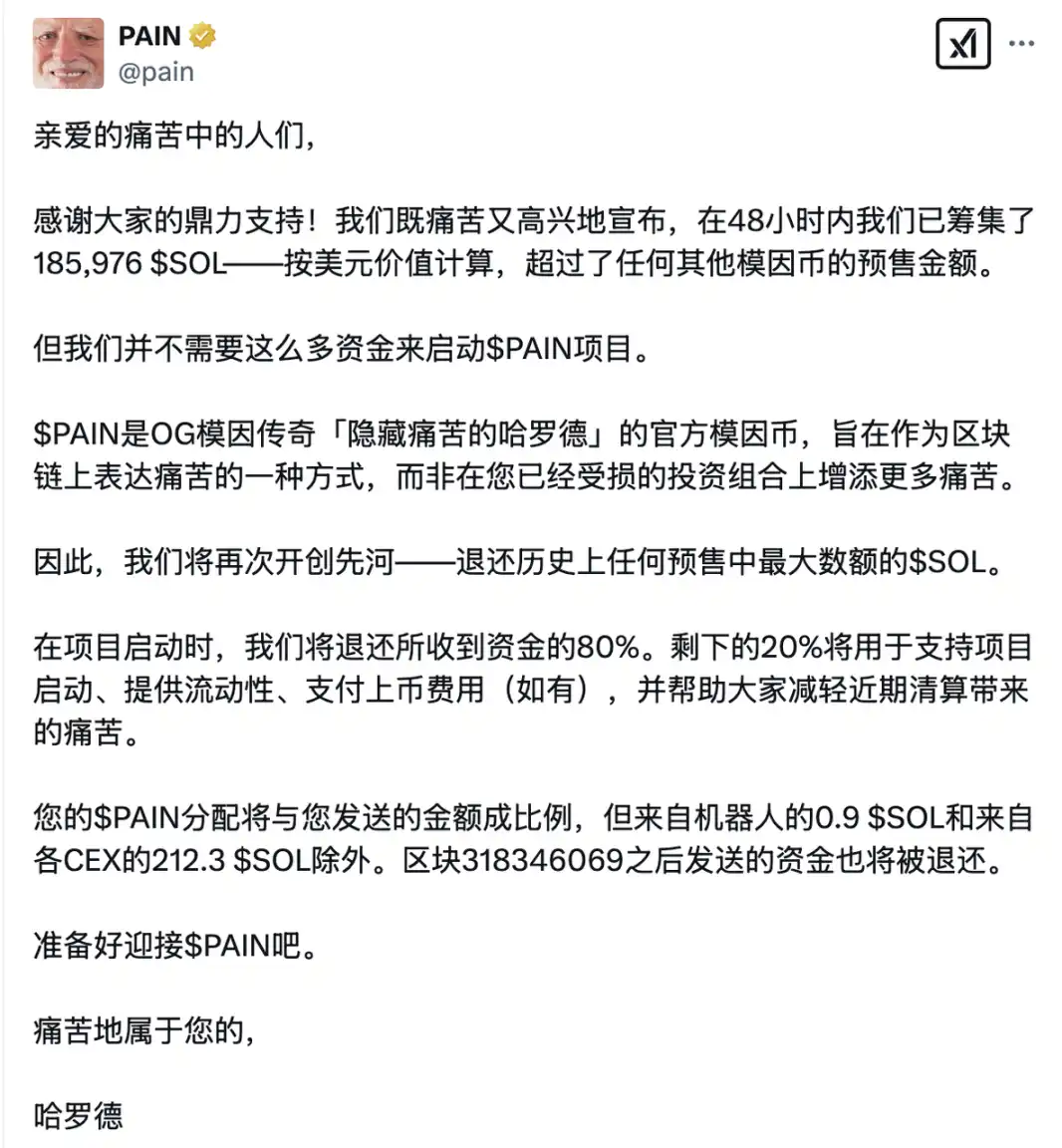
On February 2, 2025, a highly anticipated Meme coin presale within the crypto community commenced. The PAIN project, incubated by Memeland, raised a staggering 186,000 SOL tokens (approximately $38 million) within 48 hours, making it one of the largest Meme coin presales in history. However, the project team later announced a disruptive decision: to refund 80% of the funds raised, retaining only 20% for launch and liquidity. This move not only sparked discussions about the project's "integrity" but also quickly turned PAIN into a focal point of attention.
Origin: From "Smiling through Pain" to Crypto Symbol
The inspiration behind PAIN stems from the classic internet meme "Hide the Pain Harold," whose prototype is Hungarian photographer András Arató. In the early 2000s, his "smiling through pain" expression showcased in a photography equipment advertisement became an internet cultural symbol due to its strong contrast. For over a decade, Harold's image has been widely used to express life's frustrations and forced smiles, with Arató himself adopting the identity with a humorous attitude, becoming the "living meme."

Memeland's Hype: Celebrity Endorsements and Community Schism
As a project incubated by Memeland, PAIN's eruption was closely tied to the mother platform's resource allocation. By the end of October 2024, after the establishment of PAIN's official Twitter account, Memeland quickly laid the groundwork:
Celebrity Effect:
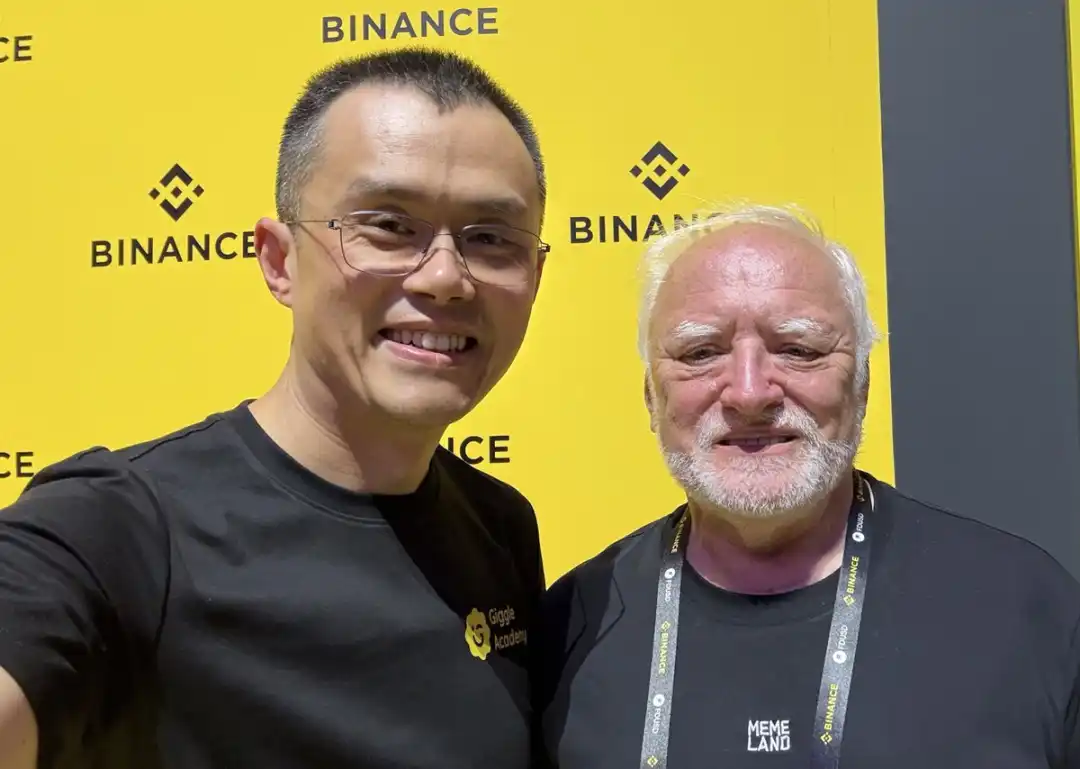
During the Binance Blockchain Week in the same October, a photo of Harold's prototype Arató with Binance founder CZ went viral. Memeland's token MEME had long been listed on Binance, and the occurrence of the photo was no doubt fueled by Memeland's efforts behind the scenes.
Community Collaboration:
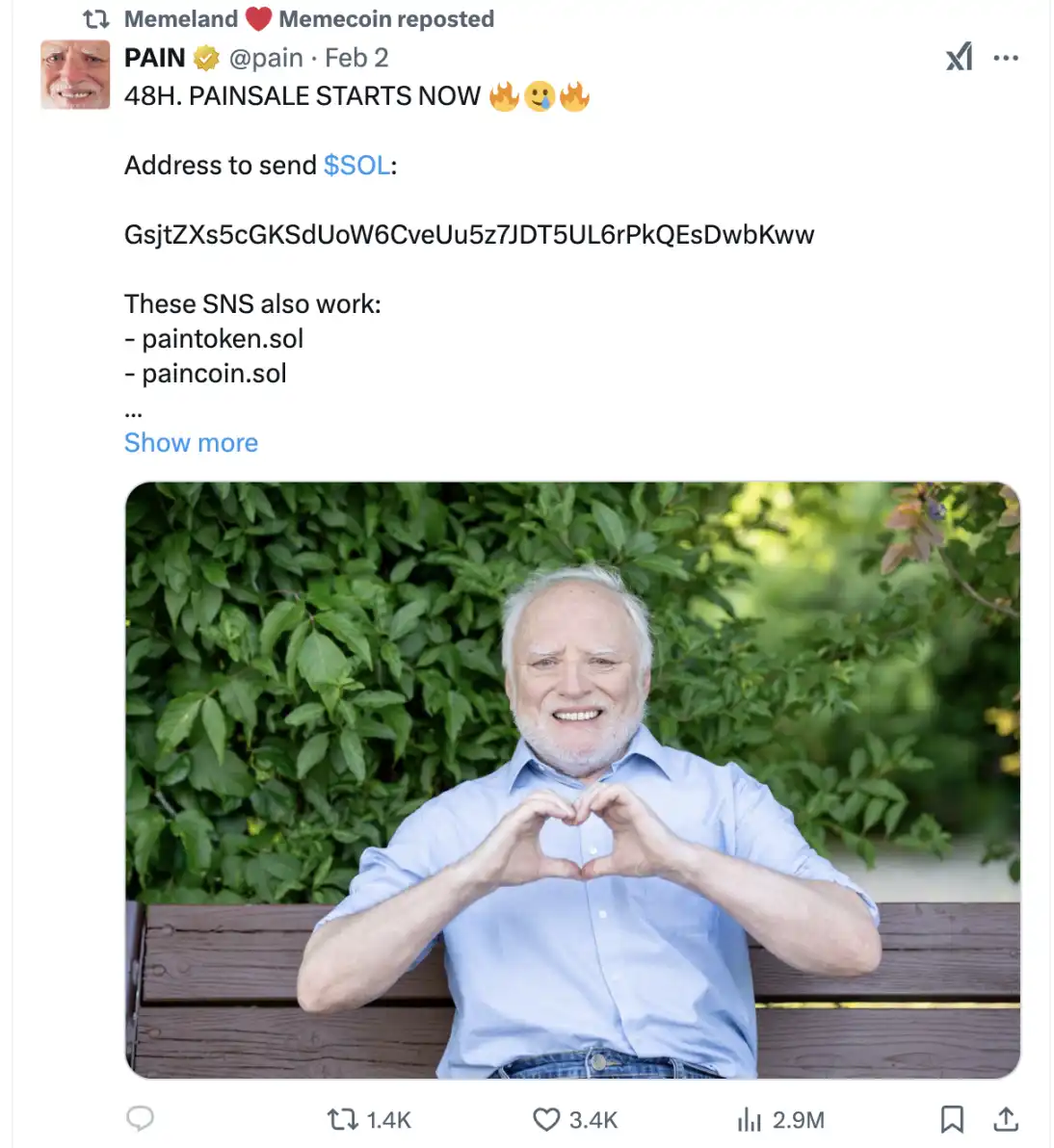
The Memeland official account has repeatedly retweeted PAIN updates, including the presale announcement, generating a resonance of traffic. (The presale is currently over, please do not send funds to the address in the image)
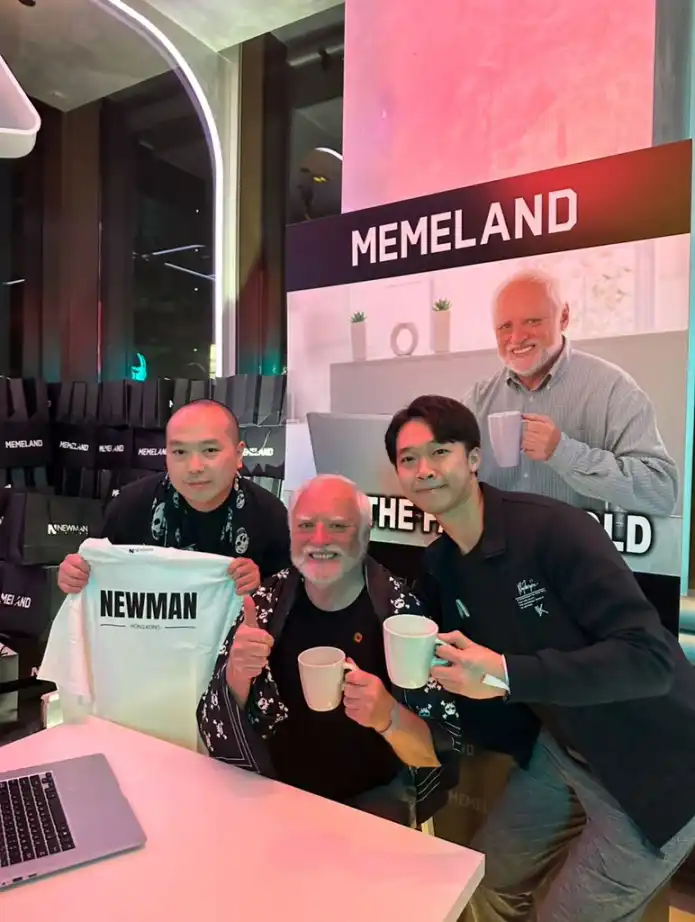
Memeland founder and Harold prototype Arató attended an offline blockchain event together.
Refund Event: Genuine Marketing or Risk Shifting?
After the presale, the project team announced a refund of 80% of the funds, retaining only 20% (approximately $7.6 million) for launch, providing liquidity, and paying CEX listing fees (if any). The official explanation stated that this was done to "reduce the burden on investors and demonstrate long-term commitment," but controversy ensued: Supporters believe that the refund reflects an "anti-rug pull" attitude, contrasting with most Meme projects that "raise funds and run"; while skeptics point out that the refunded SOL has depreciated due to market volatility, and the 20% retained funds still far exceed the launch needs of similar projects.
From a rational analysis perspective, the 80% refund amount is the highest among similar projects, and this portion of the funds can be seen as potential buying pressure after the token is listed, which indeed can be considered as protecting the returns of existing investors.
Regardless of the motive, this event objectively created a secondary spread for PAIN, achieving a significant victory in terms of traffic.
Future Challenge: The "Meme Coin" Paradox
The short-term success of PAIN relies on Memeland's community momentum and the innate virality of Meme culture (of course, not without the hype of Meme traders), but long-term development faces challenges: If Harold's "pain" core is overly commercialized, it may erode its original charm; and Meme coins rely on market hype, making them particularly vulnerable in a bear market.
The specific launch time of the PAIN token is not yet clear. Let us first observe its performance in the market before making judgments.
Conclusion
From Harold's wry smile to the successful presale of the PAIN token, this experiment has affirmed the absurdity and creativity of the crypto world. When "pain" becomes a tradable consensus, perhaps the true meme has already transcended the screen, embedded in the collective emotion of this era.
You may also like

WEEX Labs Lands at Dutch Blockchain Week: A Disruptive Crypto × AI Conversation Sets Sail in Amsterdam

SK Hynix Reportedly Plans U.S. ADR Listing as Early as August, With SEC Approval Possible in Late June
SK Hynix may pursue a U.S. ADR listing as early as August, with SEC approval reportedly possible in late June amid strong AI chip supply chain demand.

SpaceX vs Tesla vs xAI: Which Elon Musk Trade Has the Biggest Upside in 2026?

OpenAI Reveals It Has Confidentially Submitted an S-1 to the SEC, Keeping the Door Open for a Future IPO
On June 9, according to an OpenAI announcement, the company recently confidentially submitted a draft S-1 registration statement to the U.S. Securities and Exchange Commission (SEC), beginning the preliminary compliance process for a potential initial public offering. OpenAI said it chose to disclose this proactively because it expected the news might leak; however, the company has not yet set a specific listing timeline, and related arrangements may still take some time.

Latest research from 13 top universities including Cornell University: The current state, challenges, and misconceptions of the fusion of Crypto and AI
Deconstructing Anthropic: The Best AI Company, Possibly Also a Type of Organizational Invention
Apollo and Blackstone Reportedly Back $35 Billion Anthropic Chip Financing as Deal Details Remain Unclear
On June 9, according to currently available news alerts, Apollo and Blackstone Group participated in a $35 billion financing for an Anthropic “chip project.” Based on the original wording of the report, the funding has already been raised, but public information remains limited. The financing structure, use of proceeds, project entity, and whether Apollo and Blackstone participated through equity, debt, or project financing have not yet been disclosed.

Humanity Protocol Security Incident Escalates: More Than $31 Million Stolen From Related Addresses as Attacker Continues Selling H for ETH
On June 9, according to monitoring by Onchain Lens, more than $31 million has been stolen from addresses linked to Humanity Protocol, and the attack is still ongoing, with the hacker continuously swapping H tokens for ETH. Project founder Terence Kwok later confirmed the security incident on X, saying the issue involved a private key leak.

Bloomberg: As Bitcoin Weakens, Stablecoins and RWA Continue to Drive Expansion in Crypto Businesses
In June, Bloomberg reported that despite Bitcoin falling below $60,000 last week, wiping out about $235 billion in market value within seven days, and dropping close to 50% from last year’s peak, some core businesses in the crypto industry are still expanding, mainly in stablecoins, real-world asset tokenization (RWA), payments, and infrastructure. The report also noted that overall altcoin activity has contracted significantly: altcoin market capitalization has fallen from a peak of about $431 billion in November 2021 to around $170 billion, and among the tens of millions of tokens issued in recent years, fewer than 1,700 still maintain meaningful trading activity.

Galaxy Deep Research Report: How Hyperliquid's HIP-4 Upgrade Changes the Landscape of Prediction Markets?
Binance Research: RWA Market Expected to Expand Nearly 6x from Early 2025, with Public Equities and Onchain Payments Heating Up Together
In June, Binance Research said in its monthly market report that the real-world asset (RWA) market is expected to grow by about 589% from the beginning of 2025. Bond- and money market fund-related RWA expanded by about $6.5 billion, up 83% year over year, while publicly traded equity RWAs grew by about 422%. The report also noted that monthly crypto debit card transaction volume exceeded $747 million in May, up 48.6% year to date.

Japan to Assess a Framework for Yen Stablecoins and Crypto ETFs as Asia’s Compliant Payments Narrative Heats Up
Recently, according to the original report, Japan is considering the launch of yen stablecoins and cryptocurrency ETFs. Public information remains limited at this stage, and there is still no complete policy text, regulatory draft, or clear implementation timeline, so this is better characterized as a “policy discussion” rather than formal implementation. The original wording also noted that advancing stablecoin regulation in Asia is driving XRP usage and supporting growth in the XRPL ecosystem. However, based on currently available public information, there is not enough evidence to directly establish a clear causal relationship between this round of discussion in Japan and XRP or XRPL.

ZachXBT: Humanity private key leak and abnormal surge in H token should be viewed separately
On June 9, according to related disclosures, on-chain investigator ZachXBT posted an update on Humanity’s roughly $31 million security incident, saying that after further analyzing fund flows, he currently tends to believe the project team was not involved in an “inside job” or a self-staged attack. According to him, the official explanation about the private key leak was broadly accurate, but before the token unlock, the price of H had been artificially pushed higher, and the hacker later took advantage of that market environment; therefore, the private key leak and the earlier abnormal price pumping should be regarded as two separate and independent events. This reframing has shifted the market’s understanding of the nature of the incident. Earlier discussion around Humanity had focused on whether the team directly participated in the attack or used the security incident to cover up internal operations. ZachXBT’s latest remarks shift the focus from “whether it was self-theft” to “whether there were pre-unlock market structure issues.” He also questioned whether the team may have.

Morning Report | OpenAI has submitted an S-1 registration statement draft to the U.S. SEC; Morpho completes $175 million financing

Morning Report | BitMine increased its holdings by 126,971 ETH last week; trader Eugene announced his exit from the crypto market

Wang Chuan: How can one not feel anxious after the neighbor Old Wang made thirty times profit by investing in storage stocks? (Seven) - A quarter-century cycle
Cryptocurrency CEXs are flocking to sell US stocks, and traditional brokerages are facing an "uninvited guest."
$75 billion in foreign capital has fled, and South Korean retail investors have absorbed it all using leverage
WEEX Labs Lands at Dutch Blockchain Week: A Disruptive Crypto × AI Conversation Sets Sail in Amsterdam
SK Hynix Reportedly Plans U.S. ADR Listing as Early as August, With SEC Approval Possible in Late June
SK Hynix may pursue a U.S. ADR listing as early as August, with SEC approval reportedly possible in late June amid strong AI chip supply chain demand.
SpaceX vs Tesla vs xAI: Which Elon Musk Trade Has the Biggest Upside in 2026?
OpenAI Reveals It Has Confidentially Submitted an S-1 to the SEC, Keeping the Door Open for a Future IPO
On June 9, according to an OpenAI announcement, the company recently confidentially submitted a draft S-1 registration statement to the U.S. Securities and Exchange Commission (SEC), beginning the preliminary compliance process for a potential initial public offering. OpenAI said it chose to disclose this proactively because it expected the news might leak; however, the company has not yet set a specific listing timeline, and related arrangements may still take some time.
Latest research from 13 top universities including Cornell University: The current state, challenges, and misconceptions of the fusion of Crypto and AI
Deconstructing Anthropic: The Best AI Company, Possibly Also a Type of Organizational Invention


