
On-Chain Data School (Part 2): The Evergreen Profitable Hodlers, What Was Their Cost Basis for Buying BTC?


Original Article Title: "On-chain Data School (Part 2): The Evergreen Hodlers, What Is Their $BTC Acquisition Cost?"
Original Article Author: Mr. Berg, On-chain Data Analyst
TLDR
- This article will continue the concept of MVRV from the previous part, introducing LTH-MVRV
- LTH = Long Term Holder, defined as BTC held for over 155 days
- LTH-MVRV represents the profitability status of long term holders
- LTH-RP represents the average cost of long term holders
Let's now dive into the main content!
What Is LTH?
LTH = Long Term Holder, defined by Glassnode as "BTC held for over 155 days".
As for why it is 155 days, Glassnode has provided a detailed explanation on their official website; due to the complexity of the content, I will not delve into it here, but interested readers can explore it on their own.
Introduction to LTH-RP
LTH-RP, which stands for Long Term Holder's Realized Price, is essentially their average holding cost. The algorithm divides LTH-Realized Cap by the circulating supply.
As shown in the graph below, the light green color represents the overall market's Realized Price, while the dark green color represents the LTH's Realized Price. The holding cost of long term holders is usually lower than the overall market's average cost.
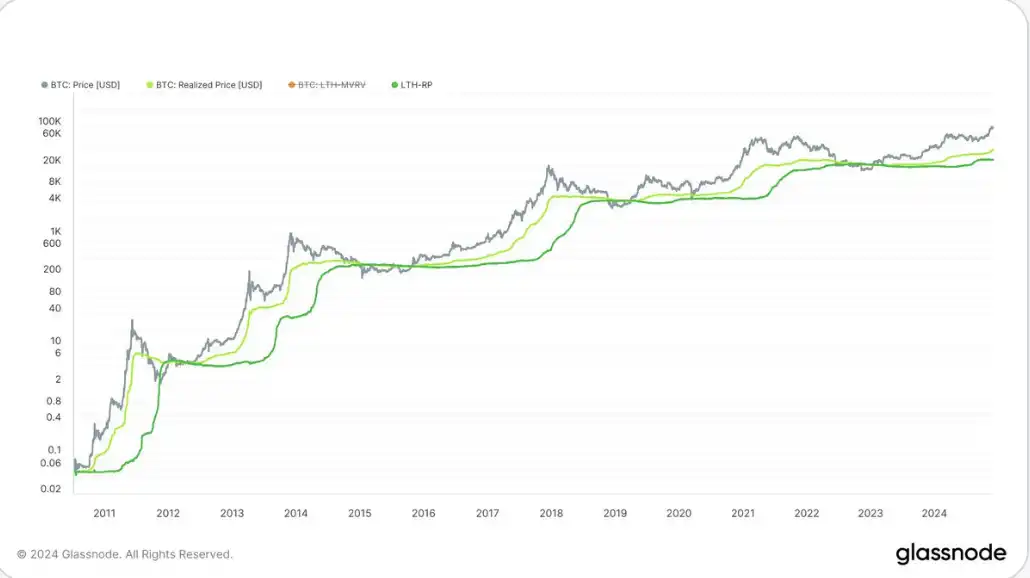
Comparison of Realized Price and LTH-RP
Introduction to LTH-MVRV
Representing the profit situation of long-term holders, similar to the calculation of MVRV, the LTH-MVRV algorithm is "current market value / LTH-Realized Cap," which can also be expressed as "current market price / LTH-Realized Price."
As shown in the chart below, the change in LTH-MVRV is usually more pronounced than MVRV, because the profits of long-term holders are usually substantial.
Comparison ofMVRV and LTH-MVRV, where the orange line represents LTH-MVRV and the yellow line represents MVRV
Application of Bottom Fishing for LTH-MVRV
When LTH-MVRV < 1 (or in other words, when the market price is below LTH-RP), it means that even the average long-term holder is at a loss, usually indicating a good bottom fishing opportunity.
As shown in the chart below, I have marked the times when LTH-MVRV < 1, which mostly correspond to cyclical major bottoms. When designing a bottom fishing strategy, this indicator can be taken into consideration~
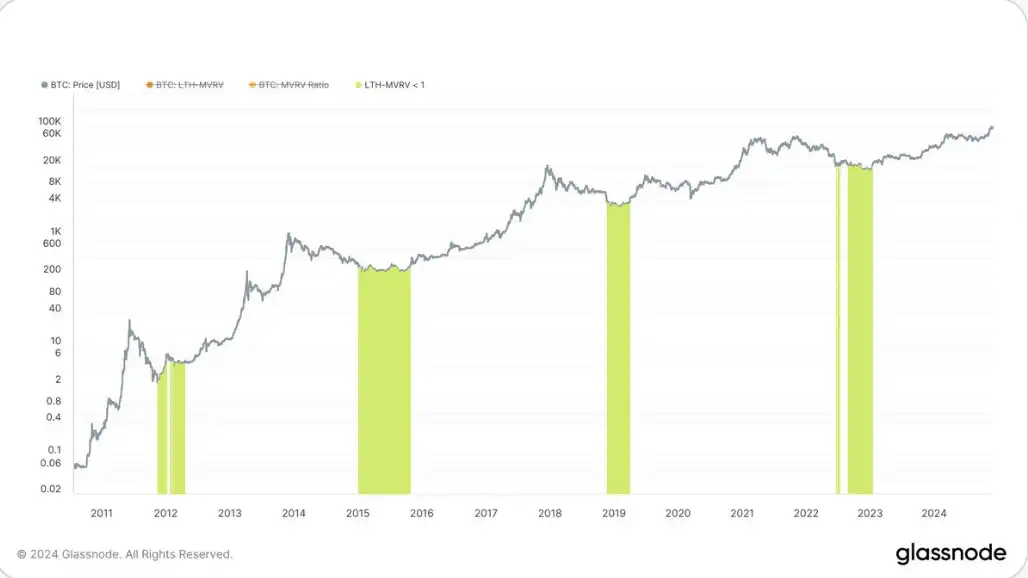
Prices corresponding to LTH-MVRV < 1
Conclusion
Above is all the content of On-Chain Data Academy (Part Two). Readers interested in delving deeper into on-chain data analysis, be sure to follow this article series!
If you want to see more analysis and educational content on on-chain data, feel free to follow my Twitter (X) account!
Hope this article has been helpful to you. Thank you for reading.
You may also like

The second half of the computing power battle: Intel CEO Pat Gelsinger reveals how AI is reshaping the global semiconductor supply chain

WEEX Live mode: Monitor 20 trading pairs at once and trade like a pro

Morning Report | Secret Network loses $4.67 million due to cross-chain vulnerability; Michael Saylor releases Bitcoin Tracker information again, may disclose increased holdings data next week

Kalshi's biggest competitor is not Polymarket
WEEX Makes Affiliate Access Easier on the Web and in the App

Customize Your Spot Trading Page: Drag Modules and Move the Order Panel Where You Want It

Perp DEX: The Next Generation Exchange "War"

10 Counterintuitive Insights on Latin American Payments

The AI gamble of mining companies: Valuations enter a phase of differentiation, and it's hard to turn the tide

A letter from Alliance to entrepreneurs: Written on the occasion of Cursor selling for 60 billion dollars
Stablecoins Finally Find Real Returns: On-Chain Reinsurance Re Explained | Interview with Re Founder Karan Saroya

The impossible triangle is simply a pseudo problem

Will MicroStrategy fall into a death spiral? What will the macro trend be in the second half of the year?

Blockchain Capital Partner: The Core Secret of Arbitrage
STRC unanchored by 11%, can the perpetual motion machine of Strategy still operate?

Bitcoin Market Analysis 2026: Can BTC Reach $150K by Year-End?
Bitcoin ETF Outflows Hit a Record $4.4 Billion: What Are Traders Doing With Their Cash?
WEEX App Just Got Smarter – New Tabs for Faster Trades & Easy Asset Management
The second half of the computing power battle: Intel CEO Pat Gelsinger reveals how AI is reshaping the global semiconductor supply chain
WEEX Live mode: Monitor 20 trading pairs at once and trade like a pro
Morning Report | Secret Network loses $4.67 million due to cross-chain vulnerability; Michael Saylor releases Bitcoin Tracker information again, may disclose increased holdings data next week
Kalshi's biggest competitor is not Polymarket
WEEX Makes Affiliate Access Easier on the Web and in the App
Customize Your Spot Trading Page: Drag Modules and Move the Order Panel Where You Want It


