
On his first day in office, Trump pardoned a veteran prisoner of the crypto community who had served 11 years.

No one understands better than Trump how to use political leverage to manipulate public sentiment.
Recently, Trump has been under some pressure. To circumvent presidential investment restrictions, on the eve of his inauguration in the "Goose City," the Trump family directly issued a coin to allow an entire interest group behind him to achieve "money for nothing" at the fastest speed.
There can be many people who harvest in the coin circle, but the one person who cannot be the president. Many members of the cryptocurrency community who once supported him openly opposed this behavior. However, there is another voice among those in the crypto community who are dissatisfied with Trump's coin issuance:
"I cannot forgive Trump for issuing a coin on the eve of his inauguration unless he releases Ross Ulbricht tomorrow."
This is a perfect example of Trump's sophisticated political maneuvering. Under pressure from the crypto industry, he immediately called the mother of Silk Road founder Ross Ulbricht and personally told the mother who has been waiting for her son to come home for ten years:
"I have just signed a full and unconditional pardon for your son Ross." Ross can come home.
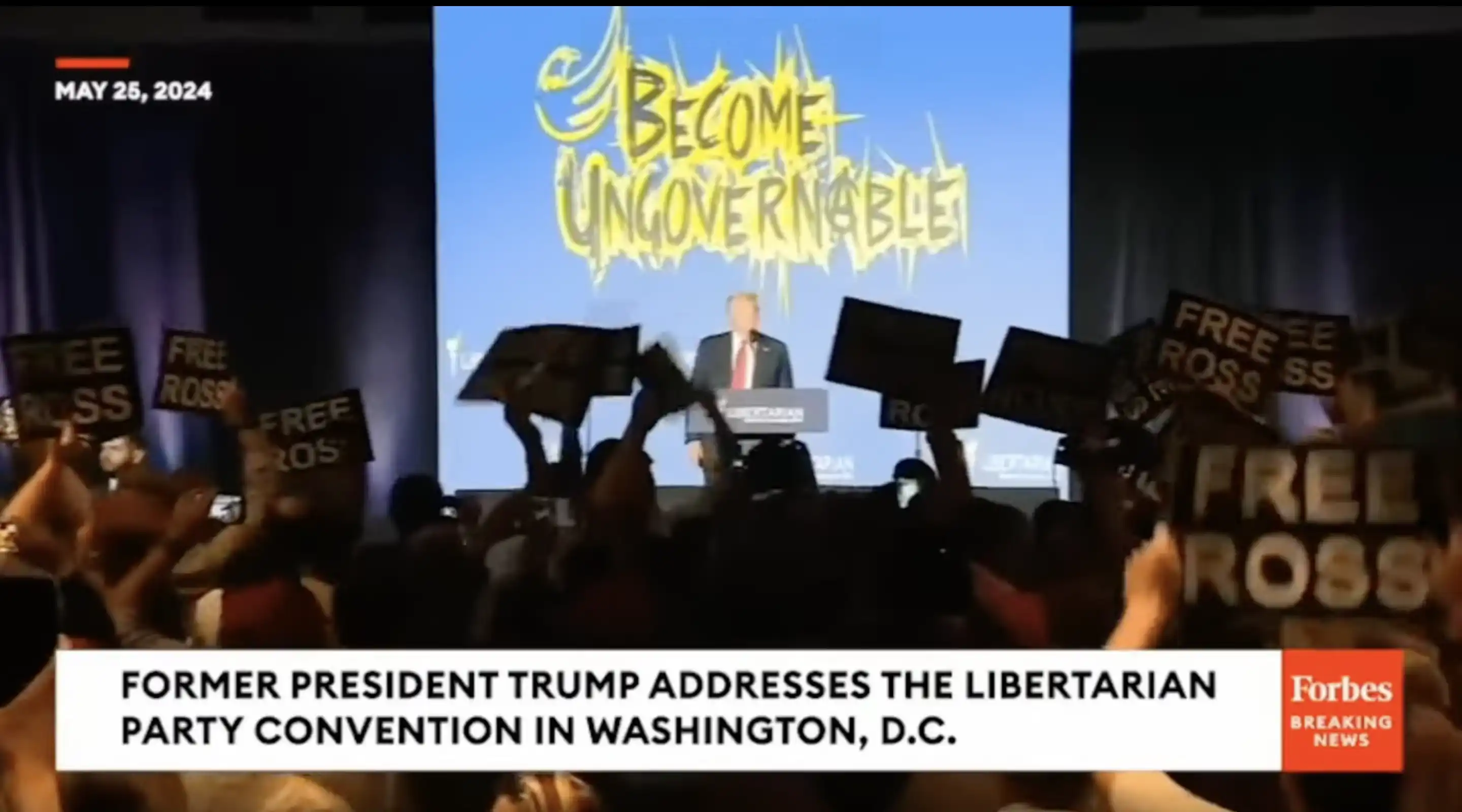
This was Trump's promise during his campaign. He promised that if re-elected, he would grant clemency or even pardon Ross on his first day in office. Six months have passed since the Bitcoin 2024 Conference, and he has already fulfilled most of his promises at that time: firing the current SEC chairman Gray Gensler, appointing a Bitcoin/crypto presidential advisory committee, granting clemency or pardon to Ross, and establishing a strategic Bitcoin reserve for the U.S. government.
Every word and action seems to prove and imply that "I will fulfill all my promises made during the campaign one by one, and the next one may be the Bitcoin strategic reserve." The Bitcoin strategic reserve is undoubtedly the G-spot of the crypto industry. This way, Trump has dampened most of the crypto industry's anger over his coin issuance.
For those far removed from the crypto industry, it may be difficult to understand why releasing Ross could appease the crypto industry's anger over Trump issuing a coin that allowed the interest group to achieve 'money for nothing'.
This story dates back to 2011 when many significant events occurred, including the killing of Bin Laden and the death of Kim Jong Il. But there were also some events that didn't seem so important at the time, such as Bitcoin's birth just two years prior. Unlike now, when one is worth $100,000, in the first one or two years after its birth, Bitcoin stayed at $0.1 per coin.
While Bitcoin may now seem like a brilliantly designed system, at the time, it was seen as a useless design by many. It wasn't until 2010 that Ross heard about Bitcoin from a client, which became a turning point.

Ross Ulbricht
In 2011, Ross founded the infamous darknet market "Silk Road," which was not a marketplace for trading tea, silk, or porcelain. Instead, it became the most well-known and notorious darknet marketplace in history. The primary commodities traded on this website were drugs, sex slaves, child pornography, hitmen, arms deals, and fake identities.

Screenshot of the Silk Road website, image source: internet
To ensure anonymity, Ross designed the platform to be accessed only through the Tor onion router (search engines couldn't access it, and entry required special software) and conducted transactions solely in Bitcoin. The government's crackdown on illicit activities revolves around financial control, which is rooted in the banking system firmly held by the government. Bitcoin, on the other hand, is a payment tool divorced from the banking system—until now, banks and Bitcoin continue to coexist separately.
With the rise of Silk Road, Bitcoin finally found its first use case as a payment instrument for illicit transactions. Data shows that the Silk Road circulated over 9.5 million Bitcoins, which accounted for 80% of the circulating supply at that time.
To his real-life friends, Ross described his work as "building an economic simulator" with the aim of using economic theory to eliminate coercion and aggression between individuals, allowing people to experience what it's like to live in a world without systemic violence.
No one could have imagined that this seemingly sunny, ambitious young man was actually a major drug lord and the architect of the underground criminal world. However, there are no airtight walls in the world, as several regulatory agencies had their eyes on him, and even an FBI informant befriended him for a lengthy three-year period.

Ross once received an email from an FBI informant offering to buy him out for 1 billion dollars, image source: internet
The DEA already knew Ross's identity by following the network cable, and the FBI's arrest of him was also quite dramatic.
In October 2013, Ross was using a bookstore's Wi-Fi when the arrest happened. To prevent Ulbricht from deleting or encrypting files on his laptop, a pair of undercover agents posing as a couple walked past him and then loudly argued next to him.
With Ross distracted by curiosity, he turned to look at them, and at that moment, one agent swiftly took his laptop, while two other agents pounced on him. The agents inserted a USB device into the laptop and used software to copy key files, as Ross's laptop was logged into the "Silk Road" admin account at the time.
On August 21, 2014, Ross was officially charged with money laundering, computer hacking, and conspiracy to traffic narcotics. On February 4, 2015, he was found guilty on all charges. On May 29, 2015, the court sentenced Ross to double life imprisonment without parole for 40 years.
Undeniably, Ross was an extremely important figure in Bitcoin's development history. Just as Bitcoin was about to be overlooked by the world, he ended Bitcoin's history as a mere toy and gave it real-world significance — serving crime.
Just as the consensus of fools is still a consensus, the demand for the dark side is still a demand. Driven by illicit transactions, Bitcoin experienced its first major price surge, reaching $31 in June 2011. However, two months after Ross's arrest, Bitcoin soared to $1,100 per coin.
Due to the practice of liberalism, during Ross's 11 years in prison, there has continued to be broad support in society, including the cryptocurrency industry, for a more lenient treatment. Many in both parties also believe that Ross's sentence was unjust and that he should be given a second chance. Over 250 organizations, public figures, and leaders have expressed support, with over 600,000 people signing a petition for Ross's release.

Today, as times have changed, with Trump's election odds steadily rising on Polymarket (a highly accurate blockchain prediction platform), most people believe that Ross may be granted clemency or even a pardon.
Similarly, in the PolyMarket betting topic "Who will Trump pardon within the first 100 days in office?" there is a high likelihood of Ross being pardoned, with the odds of Ross's pardon steadily increasing. For a long time, Ross's probability of being pardoned was 73%.
A double life sentence plus 40 years on top was indeed too heavy for the young man who was just 26 years old at the time of his arrest.
Now, with the price of Bitcoin at $105,247, the United States has also welcomed its first "Bitcoin" president. Ross, who has been in prison for 11 years, is now 41 years old and as he walks out of prison, he can finally smile in front of the camera with ease.

First Photo of Ross Ulbricht After Pardon Revealed, Image Source BitcoinMagazine
You may also like

Japan’s Three Megabanks Plan Joint Stablecoin Issuance in Fiscal 2026
MUFG, SMBC, and Mizuho reportedly plan to jointly issue fiat-pegged stablecoins in fiscal 2026, signaling Japan’s growing push into bank-led digital payment infrastructure.

Humanity Discloses H Token Dual-Chain Attack Details, With Losses on Ethereum and BSC Exceeding $36 Million
Humanity said the H token attack across Ethereum and BSC caused more than $36 million in losses after leaked ProxyAdmin keys enabled malicious contract upgrades and token minting.

White House Discusses CLARITY Act With Law Enforcement Ahead of Senate Vote
The White House discussed the CLARITY Act with law enforcement ahead of a Senate vote, focusing on illicit finance risks and developer protections.

$75 billion in foreign capital has fled, and South Korean retail investors have absorbed it all using leverage

Bitcoin Trading Guide 2026: Strategies for Experienced Traders

What Is XAUT and PAXG? Why Tokenized Gold Is Booming in 2026

Cryptocurrency CEXs are flocking to sell US stocks, and traditional brokerages are facing an "uninvited guest."

Will the SpaceX IPO Hurt Bitcoin? Here's What Traders Are Watching
Foreign selling in the South Korean stock market accelerates, with cumulative net sales reportedly reaching $75 billion this year
On June 9, The Kobeissi Letter, citing Goldman Sachs data, reported that global investors are selling South Korean stocks at an unusually rapid pace. In the latest trading session, foreign investors sold about $801 million worth of Kospi constituent stocks again; total foreign outflows last week reached about $10 billion, and the market has been in net foreign selling on nearly every trading day over the past month. According to the data cited in the report, foreign investors have sold about $75 billion worth of South Korean stocks so far this year. Meanwhile, South Korean retail and institutional investors together recorded roughly $69 billion in net buying over the same period, suggesting that the market’s main buying support has come from domestic capital rather than returning overseas funds. The information currently disclosed still mainly comes from The Kobeissi Letter’s retelling and Goldman Sachs data summaries, while public details on the statistical period and the specific definition of “selling” remain relatively limited.

Fortune Warns of Strategy’s Financing Structure Risks as Bitcoin Premium Narrows
Fortune warned that Strategy’s Bitcoin treasury model faces growing financing risks as MSTR’s net asset premium narrows and preferred stock dividend pressure increases.

Ferrari Challenge Le Mans: Carl Moon to Dominate in WEEX Livery

Sahara AI Responds to SAHARA’s Sharp Drop: No Contract or Product Security Issues Found, Internal Investigation Underway
Sahara AI responded to SAHARA’s 60% price drop, saying no token contract or product security issues have been found and an internal investigation is underway.

WEEX Deposit/Withdrawal Dynamic Island: Your Asset Status, Always in Sight
Scaling Crypto Derivatives: The Digital Asset Infrastructure Behind High-Volume Trading
In the fast-moving digital asset ecosystem, derivatives platforms face an extreme architectural test. High-leverage futures markets demand more than just standard security—they require absolute operational precision, zero-latency matching engines, and ironclad structural scalability, all while navigating intense market volatility.
As global platforms scale to meet these demands, the industry is shifting away from rigid, monolithic setups toward a more agile, "decoupled" infrastructure philosophy.
The Blueprint for High-Volume Copy TradingFor elite global exchanges like WEEX (founded in 2018), this architectural choice becomes critical when scaling high-volume retail features like social copy trading. When thousands of users automatically mirror the real-time strategies of elite traders simultaneously, it triggers sudden, monumental spikes in concurrent transactional volume.
To prevent execution latency or settlement bottlenecks during these peak volatility events, a platform's primary engine must remain entirely dedicated to risk management, copy-trade synchronization, and order matching.
The Architectural Rule: New-generation platforms must separate front-end user execution engines from heavy backend infrastructural overhead to eliminate operational friction.
By separating these layers, platforms can maintain complete sovereignty over their trading environments and user experiences while strategically aligning with institutional-grade infrastructure ecosystems. This strategic framework allows modern exchanges to leverage advanced Digital Asset Custody infrastructure such as Cobo’s behind the scenes, ensuring that backend wallet management scales elastically alongside trading spikes.
Capitalizing on Market Momentum and 400× LeverageIn a derivatives arena where platforms offer up to 400× leverage on perpetual contracts, capital efficiency and market agility are core business metrics. To capture market momentum, an exchange needs the ability to rapidly expand its asset offerings, supporting everything from legacy crypto assets to sudden, trending altcoins across a massive library of trading pairs.
Adopting a flexible, scalable Wallet-as-a-Service (WaaS) solution such as Cobo’s could completely rewrite the development timeline for high-growth exchanges. Instead of spending months of engineering capital building out custom backend wallet architectures for every new blockchain network, platforms can deploy localized infrastructure in days.
This agility allows platforms to instantly scale their listings to over a thousand trading pairs without compromising security or delaying time-to-market. It mirrors the exact operational advantages seen during high-velocity market events, similar to how advanced wallet infrastructure empowers platforms during sudden asset surges; allowing exchanges to pass that speed and liquidity directly to their global user base.
A Mature Foundation for GrowthThe synergy between trusted infrastructure ecosystems and global trading platforms represents the natural evolution of a maturing crypto market. As WEEX continues to scale its global spot and derivatives offerings for over 6 million users, adopting robust backend paradigms proves that platforms no longer have to compromise between cutting-edge trading velocity and uncompromised structural security.

Morning Report | BitMine increased its holdings by 126,971 ETH last week; trader Eugene announced his exit from the crypto market

Wang Chuan: How can one not feel anxious after the neighbor Old Wang made thirty times profit by investing in storage stocks? (Seven) - A quarter-century cycle

Get Paid to Onboard? Try WEEX’s New Homepage with Rewards for Registration, Deposit & Trade
WEEX Custom Layout: Build Your Perfect Trading Workspace in Seconds
Japan’s Three Megabanks Plan Joint Stablecoin Issuance in Fiscal 2026
MUFG, SMBC, and Mizuho reportedly plan to jointly issue fiat-pegged stablecoins in fiscal 2026, signaling Japan’s growing push into bank-led digital payment infrastructure.
Humanity Discloses H Token Dual-Chain Attack Details, With Losses on Ethereum and BSC Exceeding $36 Million
Humanity said the H token attack across Ethereum and BSC caused more than $36 million in losses after leaked ProxyAdmin keys enabled malicious contract upgrades and token minting.
White House Discusses CLARITY Act With Law Enforcement Ahead of Senate Vote
The White House discussed the CLARITY Act with law enforcement ahead of a Senate vote, focusing on illicit finance risks and developer protections.
$75 billion in foreign capital has fled, and South Korean retail investors have absorbed it all using leverage
Bitcoin Trading Guide 2026: Strategies for Experienced Traders
What Is XAUT and PAXG? Why Tokenized Gold Is Booming in 2026

Popular coins
Latest Crypto News


