
Plume Network: Bringing the Real World into the Crypto Space

Original Source
Key Points
· Real World Assets (RWAs) with a market cap exceeding $100 trillion, such as commodities, bonds, and stocks, represent the huge growth potential of the next phase in the crypto space. Institutional asset managers like BlackRock, Franklin Templeton, KKR, and Hamilton Lane are issuing tokenized RWA funds to tap into this massive market.
· As a full-stack L1 blockchain, Plume's dedicated RWA chain focuses on bringing RWAs into the on-chain RWAfi ecosystem. The platform simplifies the tokenization, liquidity management, and listing process of RWA projects by integrating core functions such as custody services and KYC/KYB verification into a single solution. The vision of Plume's RWAfi goes far beyond simple tokenization.
· By building a comprehensive on-chain ecosystem and RWA community, Plume has provided new use cases ranging from traditional assets to GPU price indices and economic indicators, blurring the boundaries between the real world and the crypto world.
· Over 180 teams are now building on the thriving Plume ecosystem, including specialized lending protocols, perpetual contracts, real estate, and even hotel booking services. This diverse range of applications showcases how the platform is transforming our interaction with RWAs, presenting them as practical products and useful services.
1. Background - Emergence of the Onchain RWA Market
1.1 Potential of RWAs in the Crypto Market
Real World Assets (RWAs) represent the next major opportunity for cryptocurrency, and for good reason: their market size is staggering. While the entire cryptocurrency market is currently valued at 3-4 trillion dollars, individual markets like commodities, bonds, and stocks each control over $100 trillion. Such a massive scale suggests the transformative potential of bringing RWAs onto the blockchain.
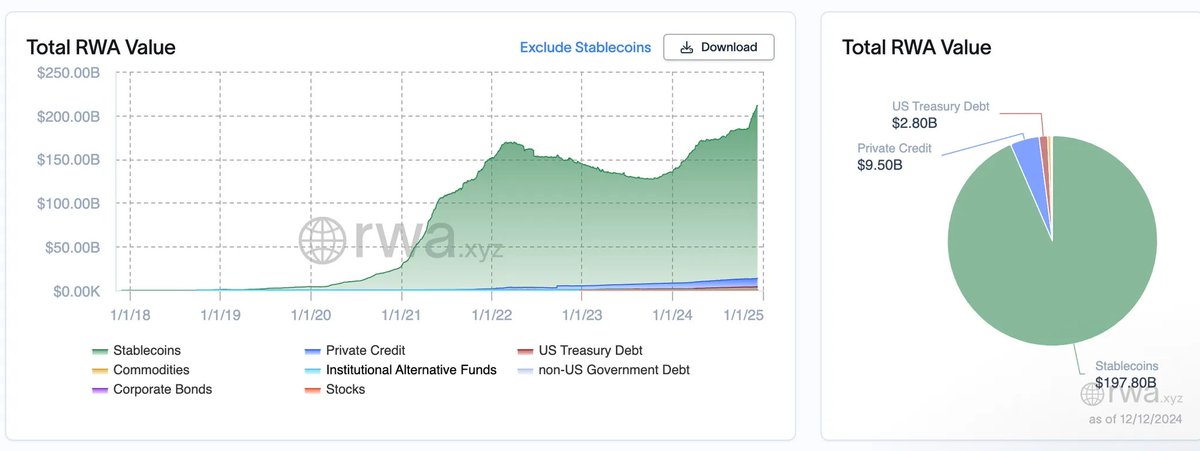
In the crypto ecosystem, the tokenized RWA market has been steadily growing and has become one of the industry's greatest success stories. Stablecoins are a leading example of RWAs, processing a whopping $10 trillion in on-chain transactions in 2023. Tether is one of the largest issuers, having minted over $130 billion in stablecoins in the first half of 2024 alone, generating $5.2 billion in profit. In the on-chain protocol space, MakerDAO has generated over $27 billion in revenue in the past 12 months, representing 40% of all DeFi protocol revenue on Ethereum.
Meanwhile, protocols like Ondo, Ethena, and Frax are accelerating the on-chain transition of traditional assets. However, despite achieving these remarkable milestones, we have only scratched the surface of the massive potential of RWA.
Source: rwa.xyz
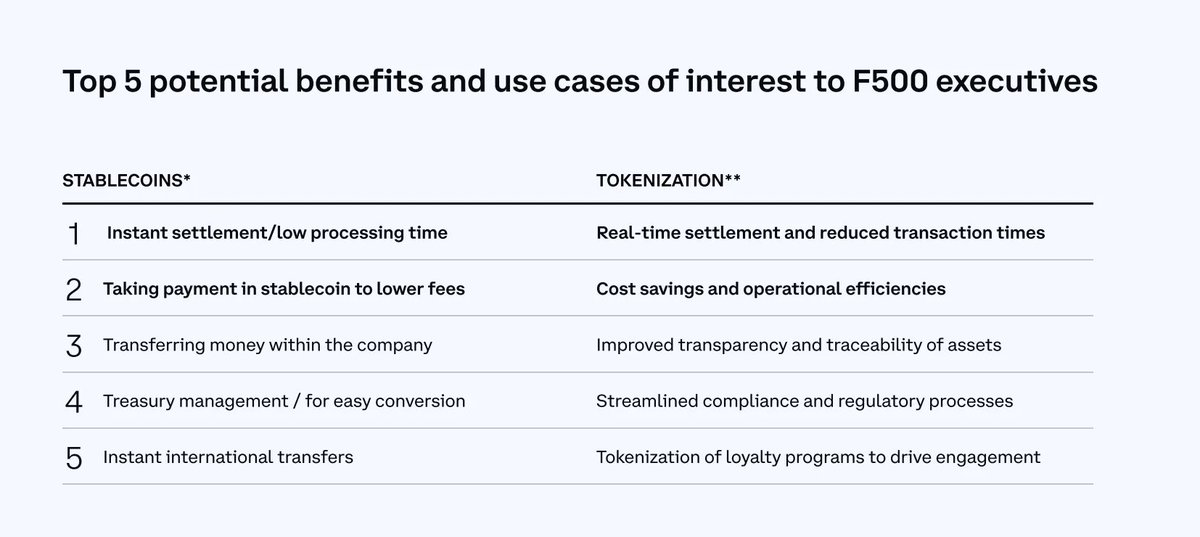
The trend of tokenization has become an undeniable fact. Coinbase's analysis shows that in the first quarter of 2024, Fortune 100 companies launching on-chain initiatives saw a 39% year-over-year growth. While stablecoins remain a major driver of tokenization growth, interest in tokenizing off-chain assets such as U.S. Treasuries has grown rapidly. Since early 2023, the TVL of tokenized assets (excluding stablecoins) has more than doubled, reaching $30 billion—an evident indication of the market's trajectory.
Source: The Fortune 500 Moving Onchain
As technology matures and its advantages become increasingly evident, the momentum behind tokenization seems unstoppable. The next-generation financial systems being built today will seamlessly incorporate key features of tokenized assets: 24/7 availability, global instant settlement, broader market access, seamless interoperability through shared technology, and customizable transparency. These advantages provide financial institutions with enhanced operational efficiency, increased liquidity, and the foundation to create new revenue opportunities through innovative applications.
1.2 Intensifying Competition in the Tokenization Market
We have already seen the industry shift towards tokenization. Traditional financial giants like BlackRock, WisdomTree, and Franklin Templeton are increasing their deposits in on-chain tokenized funds, while Web3-native projects like Ondo, Superstate, and Maple Finance are accelerating the adoption of tokenized money market funds. In a recent interview, BlackRock's CEO Larry Fink emphasized this trend, stating: "We believe the tokenization of financial assets is the direction of the next stage of evolution. Every stock, every bond will exist on a universal blockchain."
Source: Tokenization: The Future of Commodities
Mainstream protocols have not overlooked this opportunity either. Both large and small protocols are vying for a share of this massive market:
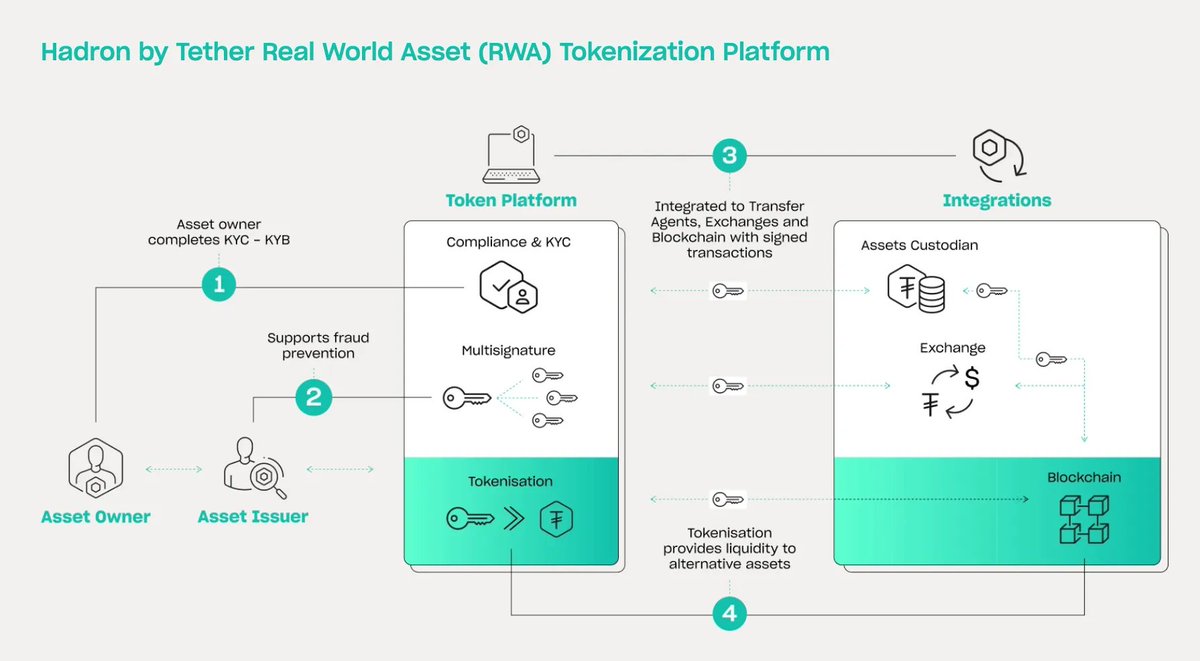
· The largest stablecoin issuer USDT, Tether, is entering the broader asset tokenization space through its "Hadron" platform. The platform offers comprehensive services for token issuance and management, including KYC/AML, risk management, and secondary market monitoring. It particularly focuses on helping nations and enterprises leverage alternative financing opportunities.
· Ripple has announced the launch of the first tokenized money market fund on the XRP Ledger (XRPL). In partnership with the UK's Archax and Abrdn, the project aims to tokenize a portion of a £3.8 billion liquidity fund and plans to bring real-world assets of more asset managers onto the XRPL.
· Aptos is building "Aptos Ascend," an institutional-grade digital asset management platform. The platform, built on Microsoft Azure technology, combines SK Telecom's Web3 wallet infrastructure and Brevan Howard's financial market expertise. Its core mission is to help institutions efficiently manage digital assets, expand tokenized asset liquidity globally, and maintain compliance.
2. Plume Enables RWAfi
2.1 Plume Network: A Blockchain Built for RWAs
The Plume Network is a full-stack architecture and ecosystem designed specifically for the integration and use of on-chain RWAs. Its notable feature is the native integration of tokenization processes and compliance mechanisms into the blockchain architecture, allowing RWA holders and institutional investors to leverage the advantages of on-chain systems without needing extensive technical knowledge or complex infrastructure development.
This L1 RWA chain design is able to withstand attacks that general-purpose blockchains cannot handle, especially when billions of dollars in RWA assets are on-chain. By introducing a new security model called Proof-of-Representation, the tokenized RWAs themselves become part of the blockchain security model, directly tying their security to asset value.

Source: Relevance of onchain asset tokenization in「crypto winter」
The current on-chain RWA market faces a classic bootstrap problem. Market participants are caught in a stalemate: liquidity providers hesitate without strong asset options, and asset providers are unwilling to tokenize without guaranteed market depth. This self-reinforcing cycle presents a significant hurdle to market growth. Plume breaks this challenge by breaking down the tokenization process into manageable components and providing an integrated management solution, allowing RWA projects to effectively enter the market and explore different approaches.
The process of bringing real-world assets (RWA) on-chain still faces multiple barriers. Service providers need to address regulatory uncertainty, the complexity of access control management, technical implementation challenges, custody issues, licensing requirements across different jurisdictions, and market fragmentation. For example, real estate tokenization platform RealtyX reported that “in the three-year service construction process, two years were spent establishing on-chain service providers and workflows.” This complex service provision process results in lengthy project implementation, thereby limiting the potential of the RWA market.
Source: Plume
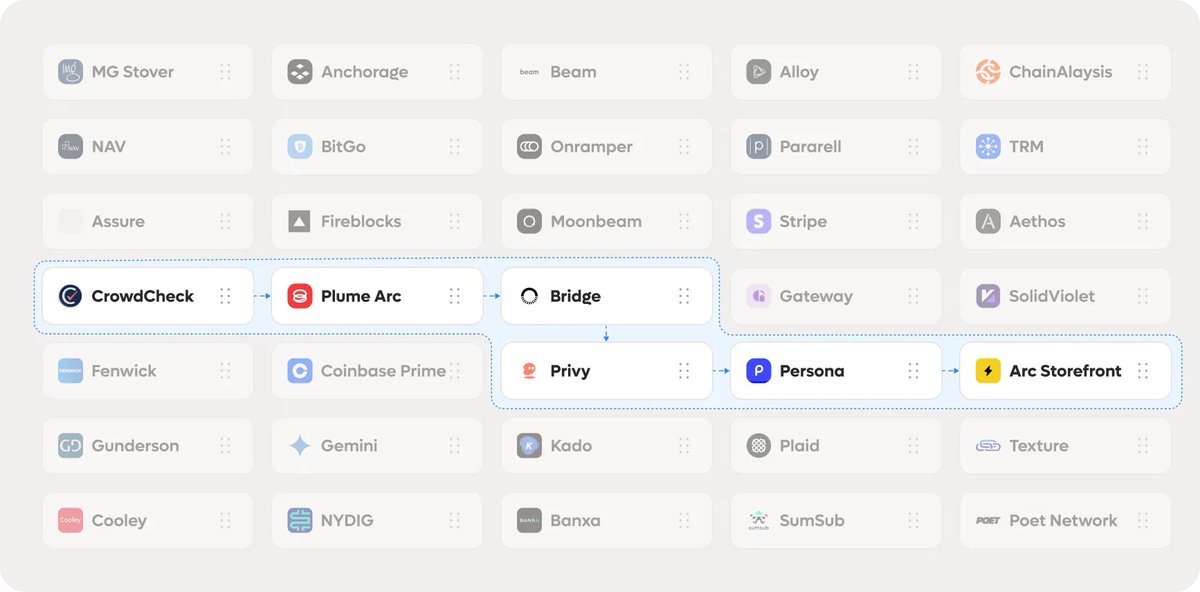
To address these challenges, Plume has integrated over 50 different functionalities into a unified platform specifically designed for RWA tokenization. These functionalities combine the basic legal and managerial functions required for on-chain RWA tokenization, including custody services, on/off-chain channels, and KYC/KYB compliance systems. Plume has not implemented a fixed or prescriptive framework but offers these functionalities as configurable modules, allowing projects to choose and implement only the features they need. These functionalities are integrated to work closely to facilitate efficient data flow throughout the system.
Plume Arc is the core of the network, serving as a comprehensive infrastructure solution for service providers looking to onboard Real World Assets (RWA) onto the blockchain. Through a streamlined tokenization process, Plume Arc significantly reduces the time and resources required for asset issuance. Service providers can leverage the compliance tools and asset management features provided by the Plume Network to greatly reduce technical complexity and legal uncertainty, allowing them to focus more on RWA-based service operations.
Plume's architecture lowers the barriers to entry that have hindered the adoption of RWAs on-chain. By handling the underlying infrastructure needs for projects, Plume enables teams to focus on core business development, helping the RWA market attract more high-quality liquidity providers and asset suppliers, driving market growth and expansion.
2.2 RWAfi: Blurring the Line Between Reality and On-chain
Source: 3DCenter.org
RWA is seen as a potential driver of growth in the next stage of the on-chain economy. By bringing off-chain assets into the blockchain system, the range of asset types that can participate in the crypto ecosystem has been greatly expanded. This not only adds new asset types but more importantly establishes a direct connection to the real world, bringing simultaneous expansion of market value and user base.
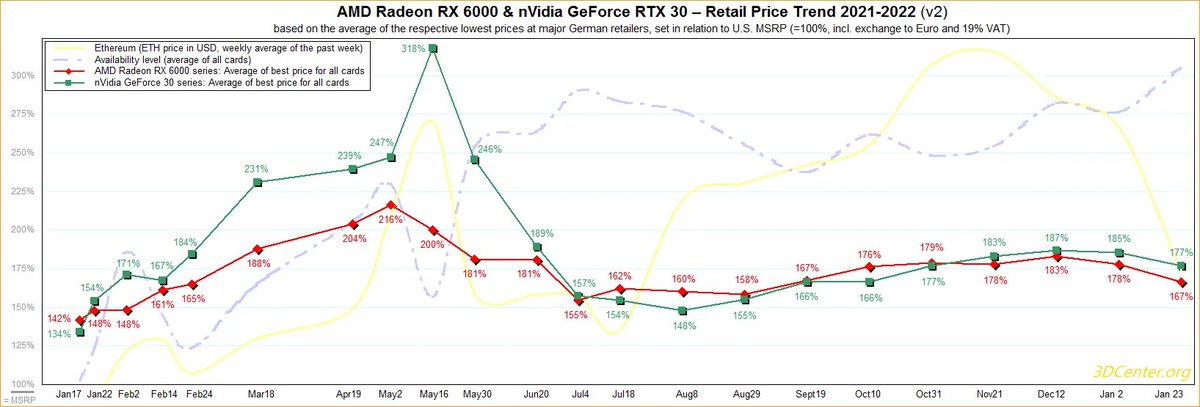
Take the tokenization of the GPU market, for example. The volatility of GPU prices is often closely related to demand for AI model training and Bitcoin mining. Traditionally, investors could only indirectly participate in the GPU market by buying stocks such as NVIDIA or Bitcoin. In Plume's RWA market, the GPU price index can be directly put on-chain, allowing traders to directly invest or hedge against GPU price movements.
The concept of tokenization is not limited to tangible assets; Plume has also introduced abstract economic indicators into the investment field. Users can invest or hedge against macroeconomic indicators through Plume's platform—from national and city economic growth rates to unemployment data and even indicators related to climate change. This framework breaks down the traditional barriers between conventional finance, the crypto market, and real-world economic activities, providing a brand-new market structure and economic interaction model.
Source: DeFi's Permissionless Composability is Supercharging Innovation
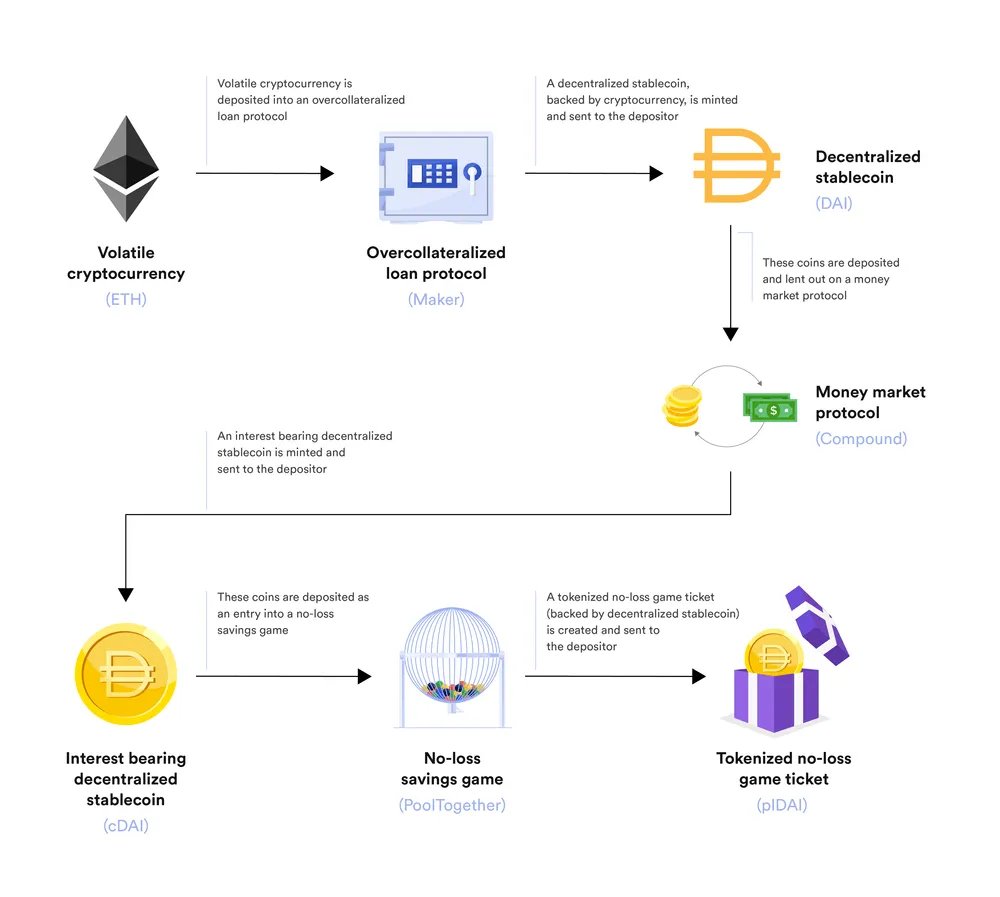
Most RWA projects primarily focus on the fundamental task of registering off-chain assets in a blockchain system. Plume goes a step further by introducing the concept of RWAfi—an on-chain ecosystem built around RWAs. The true advantage of an on-chain ecosystem lies in its composability and permissionless nature. The growth of DeFi is not driven by the success of a single protocol but by multiple protocols interconnected to create a larger ecosystem.
The same principle applies to RWAs—their true potential comes not only from registering assets on-chain but from creating an ecosystem where these assets can be traded, generate returns, act as loan collateral, and interact with various protocols. For example, tokenized real estate can be used as loan collateral, and investors can also build a globalized investment portfolio through a protocol. Plume's vision is to drive the realization of this innovative model through RWAfi.
Source: Plume Network
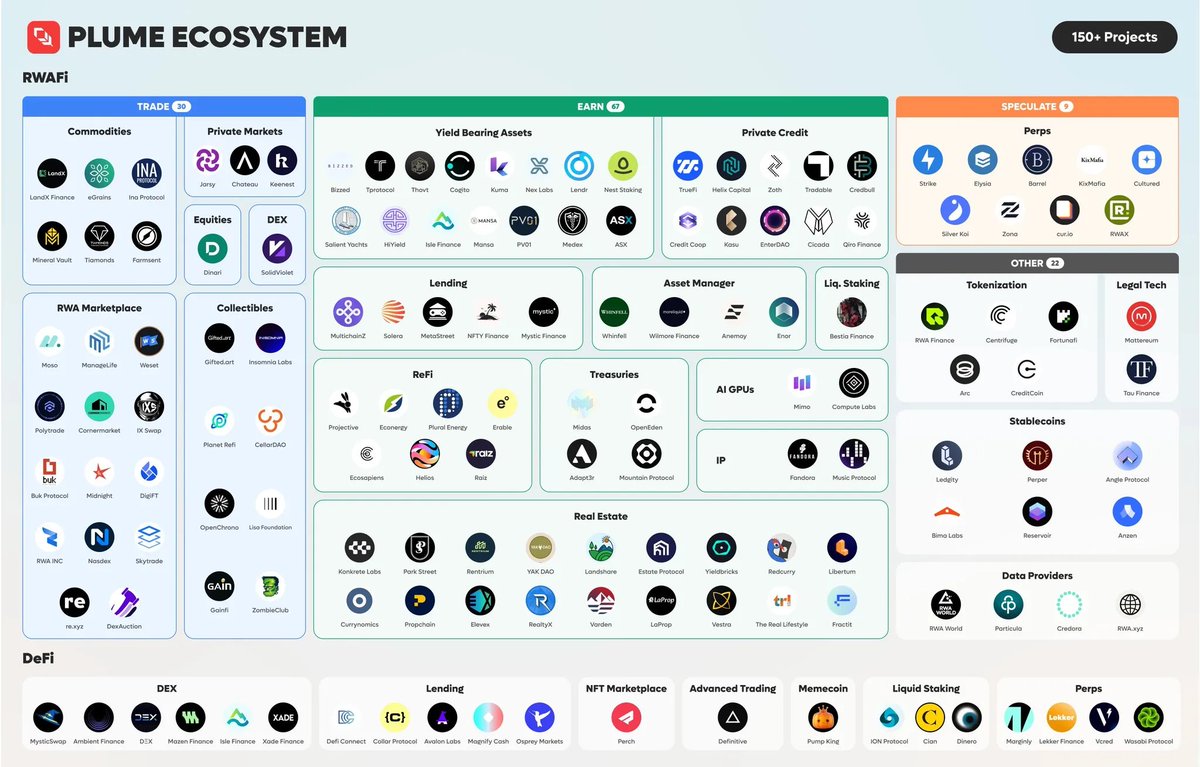
Plume maintains a diverse ecosystem, offering various services to unleash the potential of RWAfi. Users can earn rewards through multiple channels, including earning a 20% stablecoin and token yield through actual farm staking or trading on-chain sports cards and Pokémon cards, or even engaging in leveraged investments in Jordan sneakers or political events.
The Plume ecosystem currently hosts over 180 projects from various sectors, including RWA-specific lending protocols, RWA-specific perpetual futures DEX, real estate and stock tokenization protocols, collectibles markets, and consumer applications such as hotel booking services. The Plume ecosystem is not just about bringing traditional financial assets on-chain but also creating entirely new market opportunities for assets that were once illiquid or hard to access.
You may also like

Cryptocurrency CEXs are flocking to sell US stocks, and traditional brokerages are facing an "uninvited guest."

Will the SpaceX IPO Hurt Bitcoin? Here's What Traders Are Watching
Foreign selling in the South Korean stock market accelerates, with cumulative net sales reportedly reaching $75 billion this year
On June 9, The Kobeissi Letter, citing Goldman Sachs data, reported that global investors are selling South Korean stocks at an unusually rapid pace. In the latest trading session, foreign investors sold about $801 million worth of Kospi constituent stocks again; total foreign outflows last week reached about $10 billion, and the market has been in net foreign selling on nearly every trading day over the past month. According to the data cited in the report, foreign investors have sold about $75 billion worth of South Korean stocks so far this year. Meanwhile, South Korean retail and institutional investors together recorded roughly $69 billion in net buying over the same period, suggesting that the market’s main buying support has come from domestic capital rather than returning overseas funds. The information currently disclosed still mainly comes from The Kobeissi Letter’s retelling and Goldman Sachs data summaries, while public details on the statistical period and the specific definition of “selling” remain relatively limited.

Fortune Warns of Strategy’s Financing Structure Risks as Bitcoin Premium Narrows
Fortune warned that Strategy’s Bitcoin treasury model faces growing financing risks as MSTR’s net asset premium narrows and preferred stock dividend pressure increases.

Ferrari Challenge Le Mans: Carl Moon to Dominate in WEEX Livery

Sahara AI Responds to SAHARA’s Sharp Drop: No Contract or Product Security Issues Found, Internal Investigation Underway
Sahara AI responded to SAHARA’s 60% price drop, saying no token contract or product security issues have been found and an internal investigation is underway.

WEEX Deposit/Withdrawal Dynamic Island: Your Asset Status, Always in Sight

Scaling Crypto Derivatives: The Digital Asset Infrastructure Behind High-Volume Trading
In the fast-moving digital asset ecosystem, derivatives platforms face an extreme architectural test. High-leverage futures markets demand more than just standard security—they require absolute operational precision, zero-latency matching engines, and ironclad structural scalability, all while navigating intense market volatility.
As global platforms scale to meet these demands, the industry is shifting away from rigid, monolithic setups toward a more agile, "decoupled" infrastructure philosophy.
The Blueprint for High-Volume Copy TradingFor elite global exchanges like WEEX (founded in 2018), this architectural choice becomes critical when scaling high-volume retail features like social copy trading. When thousands of users automatically mirror the real-time strategies of elite traders simultaneously, it triggers sudden, monumental spikes in concurrent transactional volume.
To prevent execution latency or settlement bottlenecks during these peak volatility events, a platform's primary engine must remain entirely dedicated to risk management, copy-trade synchronization, and order matching.
The Architectural Rule: New-generation platforms must separate front-end user execution engines from heavy backend infrastructural overhead to eliminate operational friction.
By separating these layers, platforms can maintain complete sovereignty over their trading environments and user experiences while strategically aligning with institutional-grade infrastructure ecosystems. This strategic framework allows modern exchanges to leverage advanced Digital Asset Custody infrastructure such as Cobo’s behind the scenes, ensuring that backend wallet management scales elastically alongside trading spikes.
Capitalizing on Market Momentum and 400× LeverageIn a derivatives arena where platforms offer up to 400× leverage on perpetual contracts, capital efficiency and market agility are core business metrics. To capture market momentum, an exchange needs the ability to rapidly expand its asset offerings, supporting everything from legacy crypto assets to sudden, trending altcoins across a massive library of trading pairs.
Adopting a flexible, scalable Wallet-as-a-Service (WaaS) solution such as Cobo’s could completely rewrite the development timeline for high-growth exchanges. Instead of spending months of engineering capital building out custom backend wallet architectures for every new blockchain network, platforms can deploy localized infrastructure in days.
This agility allows platforms to instantly scale their listings to over a thousand trading pairs without compromising security or delaying time-to-market. It mirrors the exact operational advantages seen during high-velocity market events, similar to how advanced wallet infrastructure empowers platforms during sudden asset surges; allowing exchanges to pass that speed and liquidity directly to their global user base.
A Mature Foundation for GrowthThe synergy between trusted infrastructure ecosystems and global trading platforms represents the natural evolution of a maturing crypto market. As WEEX continues to scale its global spot and derivatives offerings for over 6 million users, adopting robust backend paradigms proves that platforms no longer have to compromise between cutting-edge trading velocity and uncompromised structural security.

Morning Report | BitMine increased its holdings by 126,971 ETH last week; trader Eugene announced his exit from the crypto market

Wang Chuan: How can one not feel anxious after the neighbor Old Wang made thirty times profit by investing in storage stocks? (Seven) - A quarter-century cycle

Get Paid to Onboard? Try WEEX’s New Homepage with Rewards for Registration, Deposit & Trade

WEEX Custom Layout: Build Your Perfect Trading Workspace in Seconds

See “Buy Walls” & “Sell Walls” Instantly: WEEX Launches the Depth Chart for Smarter Trades

What Is Quick Trade on WEEX? 2 Ways WEEX Ends Chart-Panel Jumping
Morning News | Five major virtual asset platforms in South Korea have experienced 57 incidents of hacking and system failures in six years; Grayscale submits registration application for Canton ETF

Should we escape the peak? The principle of the tail-end market in the stock market

RootData: May 2026 Cryptocurrency Exchange Transparency Research Report

Founder of Baixing.com: My Experience with Claude Code in Fourteen Points
Cryptocurrency CEXs are flocking to sell US stocks, and traditional brokerages are facing an "uninvited guest."
Will the SpaceX IPO Hurt Bitcoin? Here's What Traders Are Watching
Foreign selling in the South Korean stock market accelerates, with cumulative net sales reportedly reaching $75 billion this year
On June 9, The Kobeissi Letter, citing Goldman Sachs data, reported that global investors are selling South Korean stocks at an unusually rapid pace. In the latest trading session, foreign investors sold about $801 million worth of Kospi constituent stocks again; total foreign outflows last week reached about $10 billion, and the market has been in net foreign selling on nearly every trading day over the past month. According to the data cited in the report, foreign investors have sold about $75 billion worth of South Korean stocks so far this year. Meanwhile, South Korean retail and institutional investors together recorded roughly $69 billion in net buying over the same period, suggesting that the market’s main buying support has come from domestic capital rather than returning overseas funds. The information currently disclosed still mainly comes from The Kobeissi Letter’s retelling and Goldman Sachs data summaries, while public details on the statistical period and the specific definition of “selling” remain relatively limited.
Fortune Warns of Strategy’s Financing Structure Risks as Bitcoin Premium Narrows
Fortune warned that Strategy’s Bitcoin treasury model faces growing financing risks as MSTR’s net asset premium narrows and preferred stock dividend pressure increases.
Ferrari Challenge Le Mans: Carl Moon to Dominate in WEEX Livery
Sahara AI Responds to SAHARA’s Sharp Drop: No Contract or Product Security Issues Found, Internal Investigation Underway
Sahara AI responded to SAHARA’s 60% price drop, saying no token contract or product security issues have been found and an internal investigation is underway.


