
Tutorial | How to Find KOL's Transaction Address? Includes a File of One Hundred KOL Addresses


Original Author: Zibu, Crypto KOL
Due to their influence, KOLs can have a certain impact on projects through their actions. Typically, a project's KOL would first buy in themselves, then share in the community, and finally post publicly on channels like Twitter. If we have the KOL's address, we can know immediately what they bought, when they added to their position, and when they took profits or stopped losses.
This article shares some methods for finding KOL addresses and how to use these addresses.
1. Using gmgn
gmgn is a comprehensive platform with features such as trading, data analysis, and monitoring, and its founder is Chicken Brother @haze0x.
On gmgn, users can link Twitter accounts with addresses, allowing us to find KOL addresses using this feature.
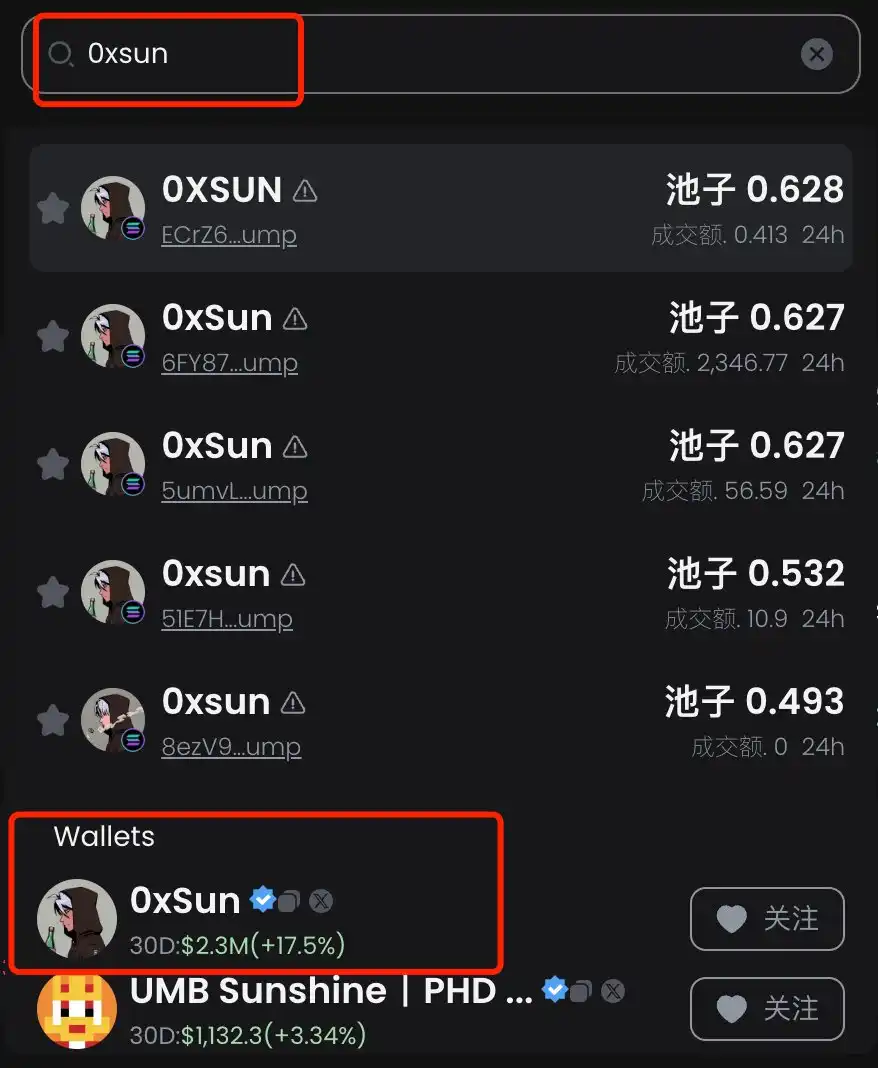
For example, if we want to know 0xsun's address, we can enter "0xsun" in the search bar, and at the bottom of the search results, 0xsun's address will appear, as shown below:
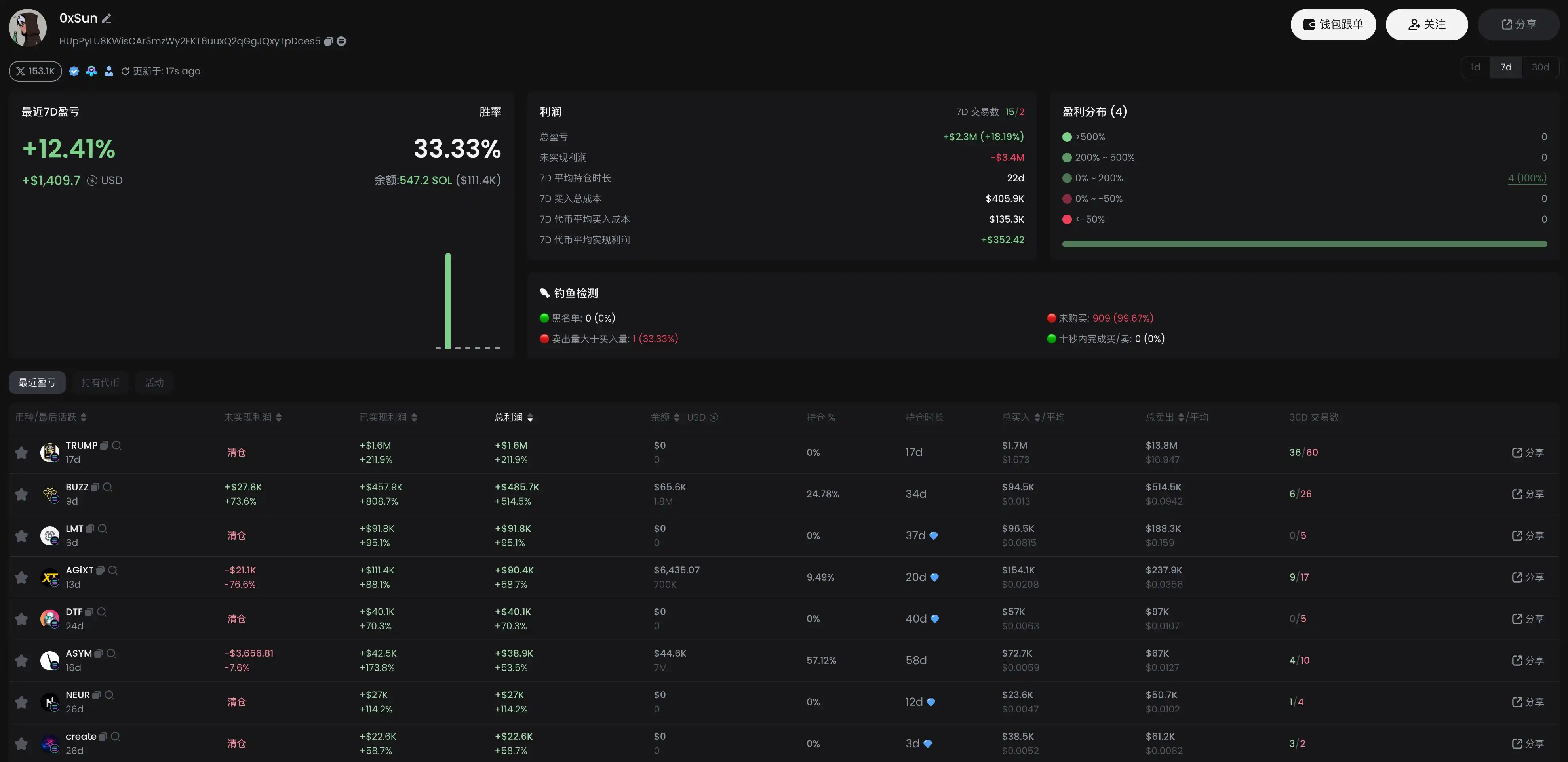
By clicking on the address in the search results, we can see detailed information about 0xsun's address, as shown. We can see his Twitter follower count, with a clickable link to Twitter; we can see his win rate; and we can see his 7-day P&L, with a 7-day profit of $2.3 million.
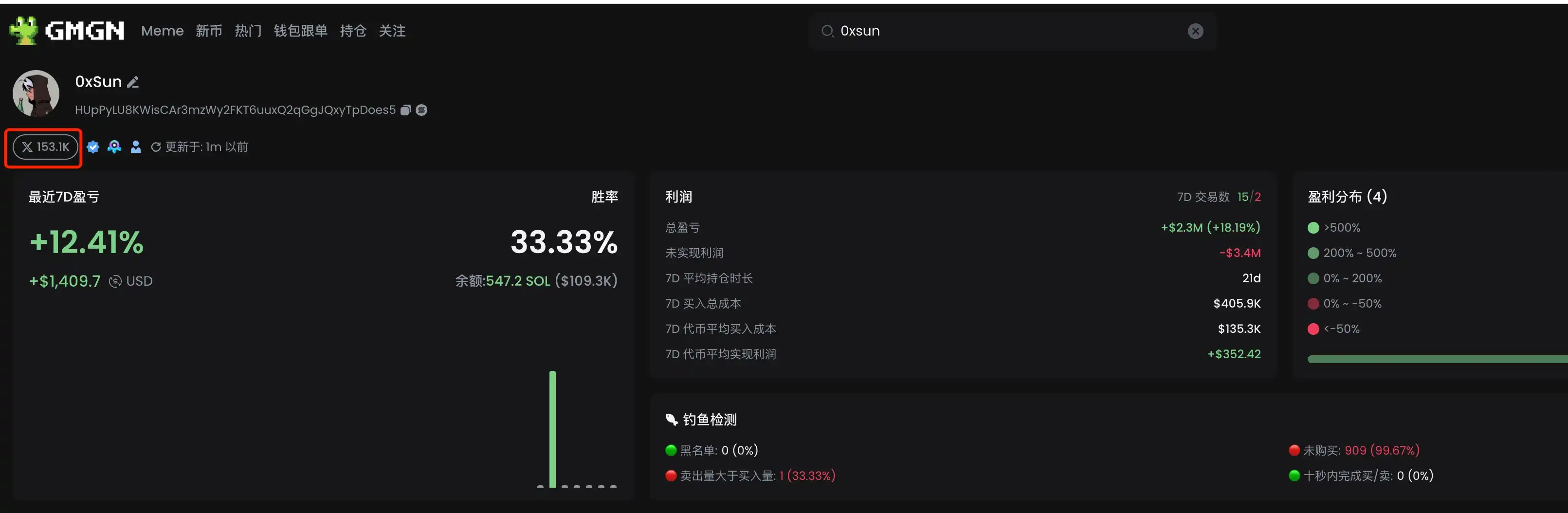
Therefore, when we want to know the address of a KOL, we can search on gmgn to see if they have linked their address. If they have, we can find it there.
2. Using chain.fm
chain.fm is an on-chain monitoring platform where users have uploaded many smart contract addresses, including those of many KOLs. The founder is @zen913.
Before the new year, chain.fm launched a search feature supporting keyword searches, allowing us to use this feature to find KOL addresses.
I have mentioned this method in my tweet https://x.com/0x_zibu/status/1882345639218118884. There are two methods to find KOL addresses using chain.fm:
1. Directly Search for a Specific KOL Name
Let's continue using 0xsun as an example. Enter "0xsun" in the input field, and you will see several addresses appear, as shown in the image below.
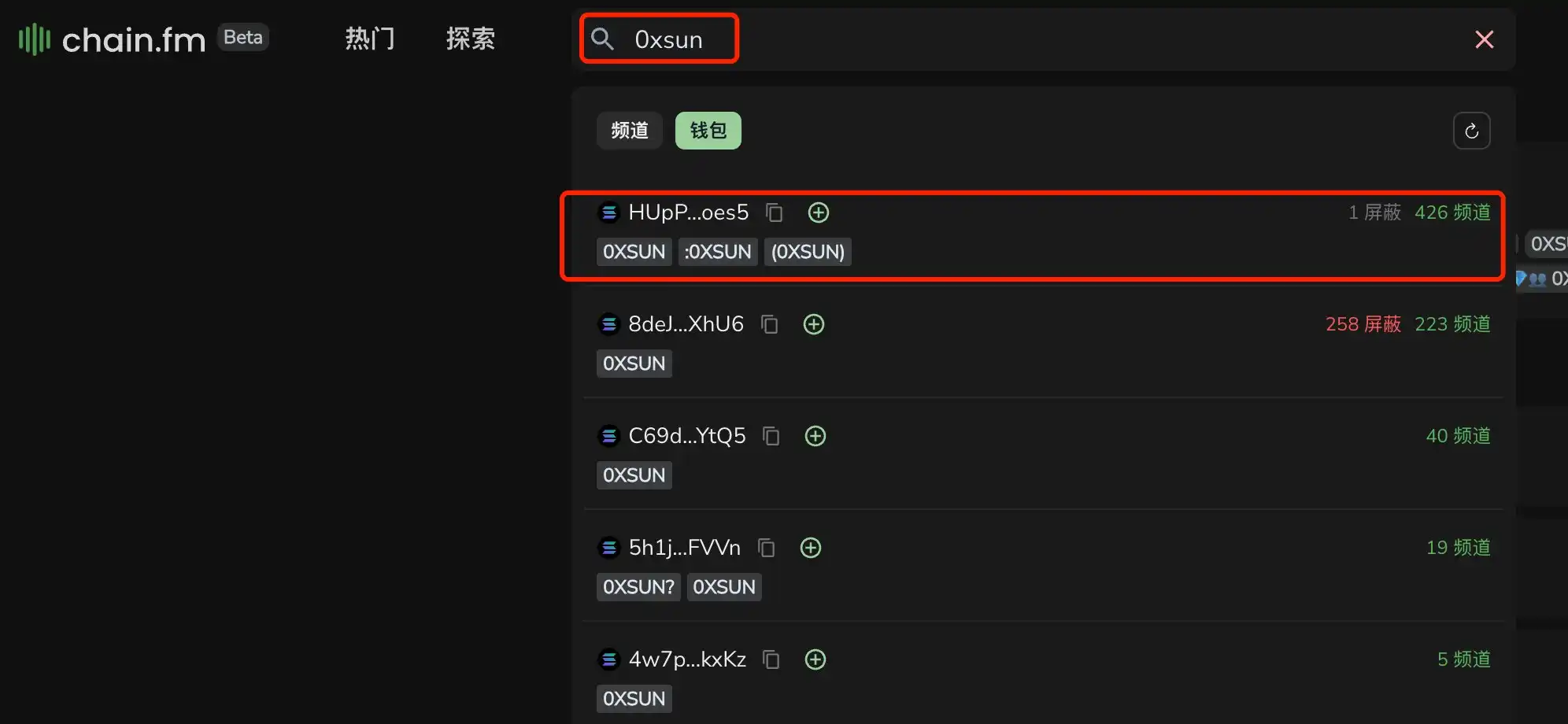
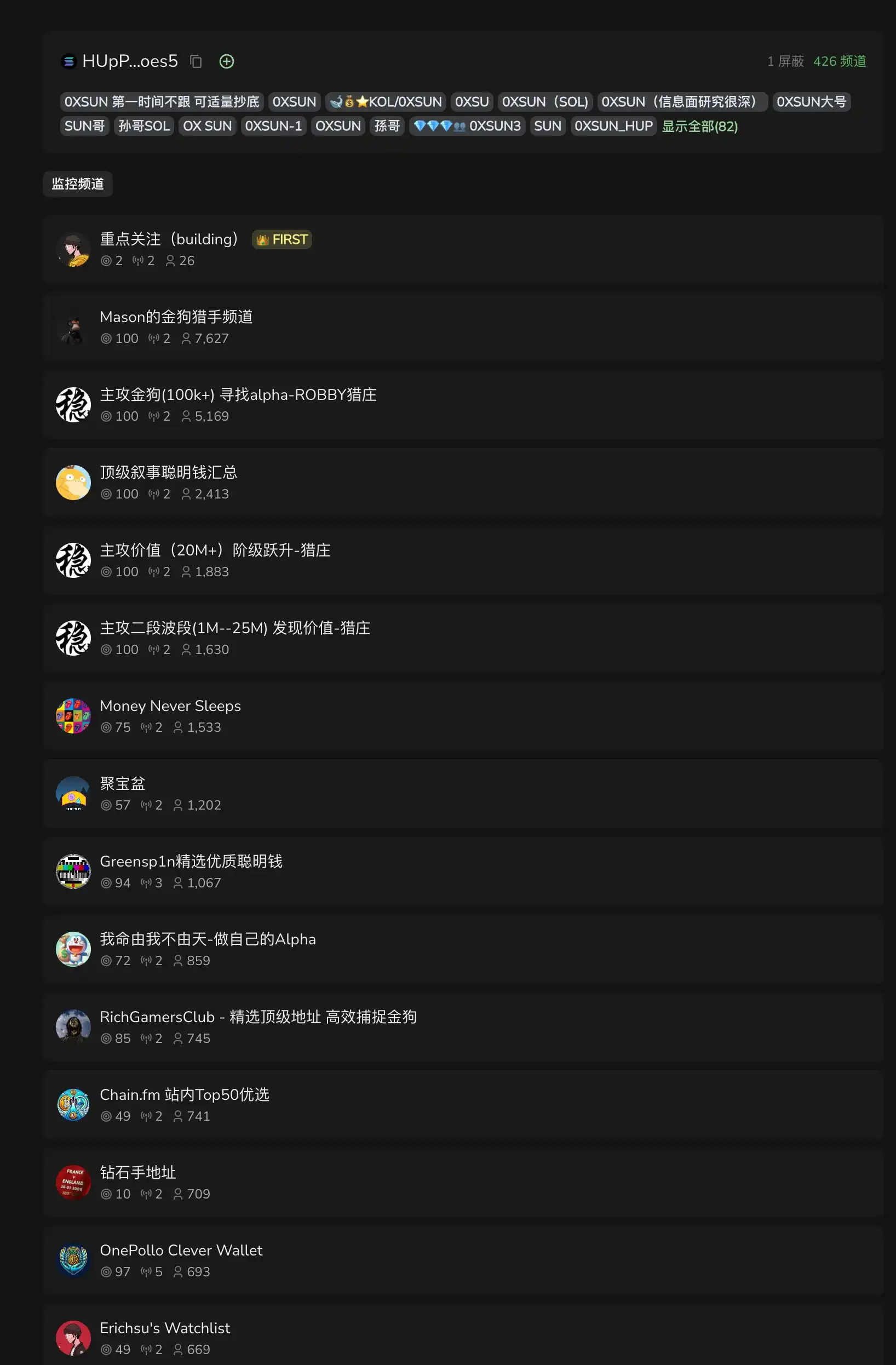
The first address in the search results is listed in 426 channels, indicating a high probability that it is 0xsun's address. You can also verify this address on gmgn to see if 0xsun has authenticated it.
2. Search Using the Keyword "KOL"
You can also enter the keyword "KOL" to search for all relevant information on chain.fm, as shown below.
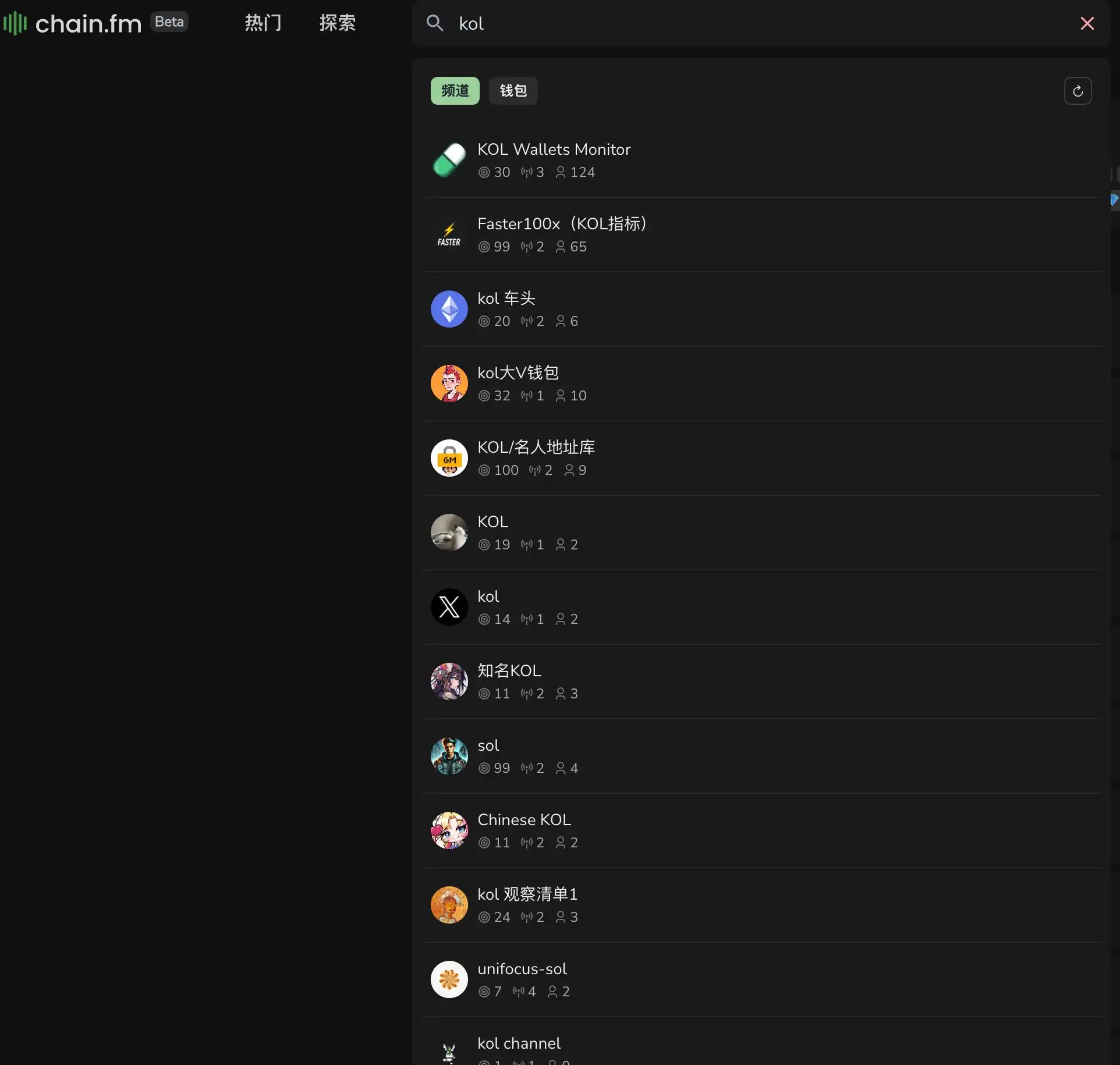
When you enter "KOL," all relevant channels will be displayed. These channels contain curated KOL addresses, and you only need to verify their authenticity.
Under the wallet option, using the keyword "KOL" will also display addresses containing this information, as shown below.

The addresses found through chain.fm are based on uploads by channel owners and cannot be guaranteed to be 100% accurate. It is necessary to cross-validate through gmgn, Twitter, or other channels.
III. Twitter-Based Forensic Analysis
The above two methods are relatively simple and can be found with some time and effort. However, some KOLs do not publicly disclose their addresses. In such cases, other methods must be used to find them.
1. Specific Display of Transactions
Some KOLs will display transactions in their tweets, including specific transaction information such as transaction time, buy or sell, transaction amount, and the quantity of the coin. It is easy to find addresses for these types of transactions as they provide specific transaction details for filtering.
For filtering such transactions, it is recommended to use DEX Screener (https://dexscreener.com/). You can filter based on transaction time, transaction type (buy or sell), transaction amount, and coin quantity, as shown in the image.

DEX Screener is one of the tools I have used with the most comprehensive manual filtering features. Unlike other tools where filtering features are superficial, I doubt even the PM uses them.
However, the drawback of TokenView is that it cannot retrieve transactions that use aggregation routes, such as those on OKX. For these transactions, you will need to check OKX's website (https://www.okx.com/en/web3) for information.
2. Vague Information
Sometimes, Key Opinion Leaders (KOL) on Twitter may not directly share their trades but instead mention entering a certain coin at a specific market cap. In such cases, the information provided is limited. Relying solely on one tweet may only give you a rough idea, and you may need to combine multiple tweets to pinpoint the exact transaction.
For example, yesterday, Cycle Bull shared Burder's address details as shown in the image. How can we identify this address?
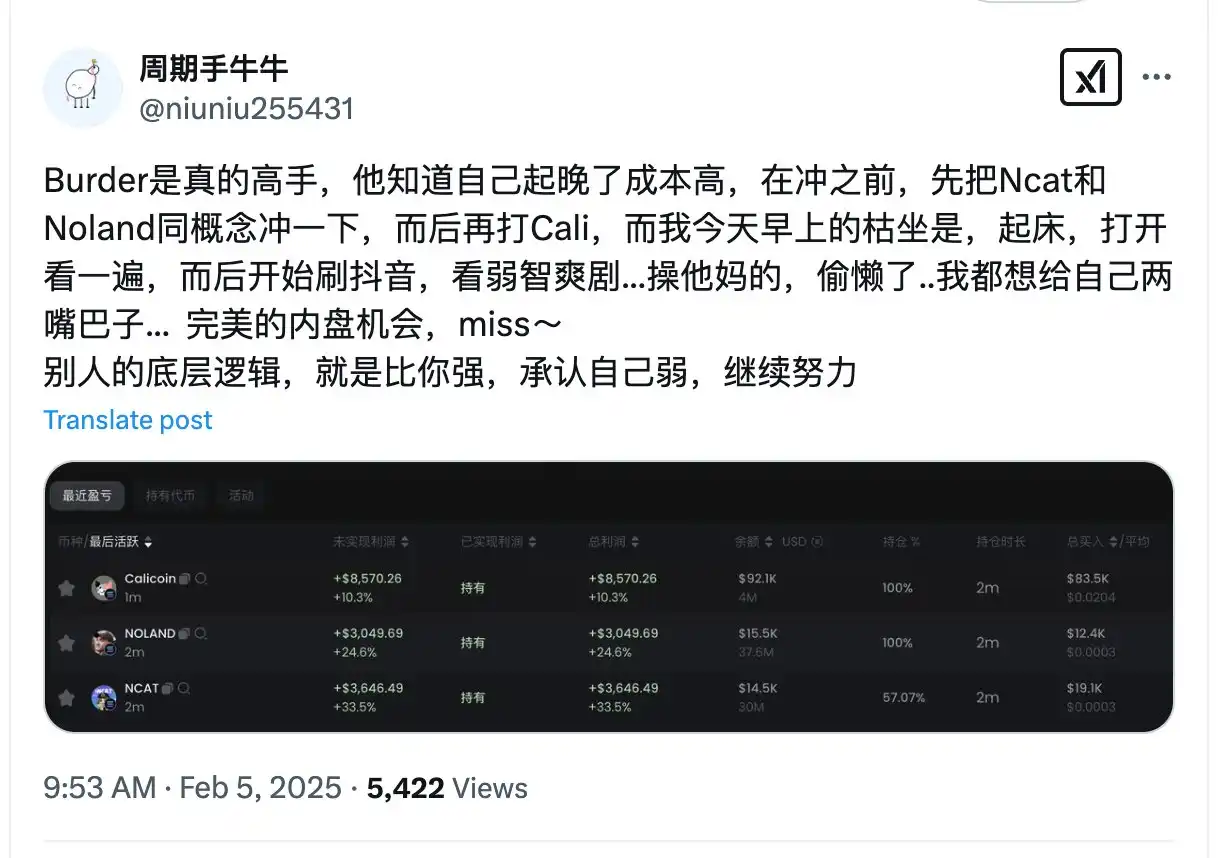
Let's first gather all the relevant information:
(1) The tweet was posted at 9:53 on 2.5
(2) Based on the tweet, Burder first bought $Ncat and $Noland, followed by a purchase of $Calicoin
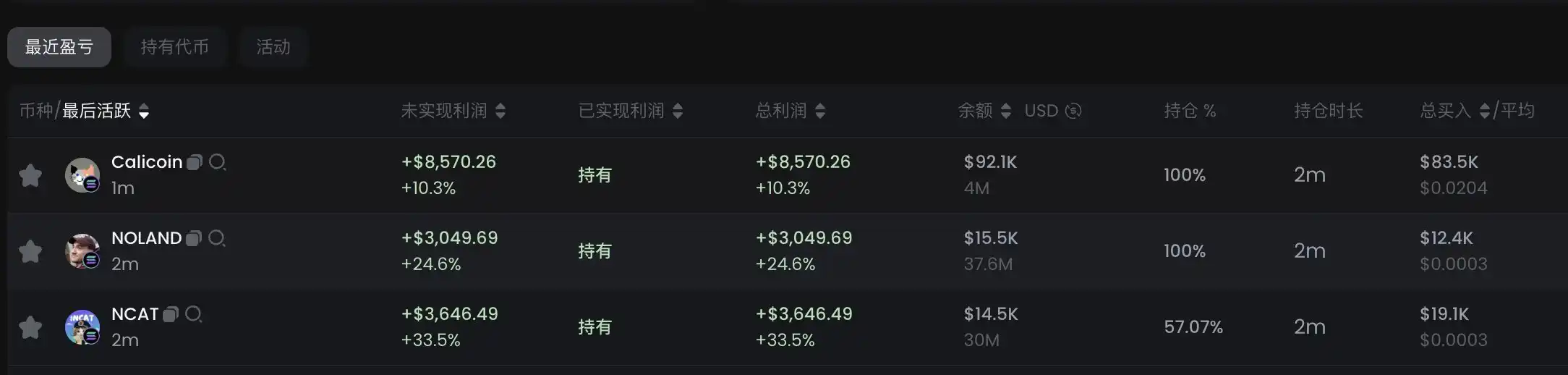
(3) The image in the tweet provides rich information, as follows:
a. The holding of $Calicoin is 4M
b. The holding of $Noland is 37.6M
c. The holding of $Ncat is 30M, but it accounts for only 57% of the total holding
d. At the time of the screenshot, their holdings were only 2 minutes old
(4) The opening time for $Calicoin was 8:23 on 2.5
From the above information, we can deduce that Burder's transaction occurred between 8:23 and 9:53, with a holding duration of 2 minutes as seen in the image. Therefore, the latest possible transaction time is 9:51. If Burder mentioned being late in the tweet, the earliest transaction time would be sometime after the opening but without specific details, so we can only start filtering from 8:23.
With this information, here's what we can do:
a. Write a script to fetch transaction data
Retrieve all buy transactions for the three coins between 8:23 and 9:53, and identify the address that made simultaneous purchases of these three coins in this timeframe, matching the order and quantity according to the collected information above.
b. Query Using Dune (https://dune.com/)
Compared to writing your own script to fetch transaction data, data on Dune is readily available. At this point, you can use AI assistance to write a Dune query statement, filter out addresses, and then manually verify them.
Four, Analyze Address Transaction Style and Win Rate
Once you have identified the KOL's address, you need to conduct a detailed analysis of this address. Look at their transaction style to see if they prefer playing in the primary market or the secondary market, whether they prefer chasing highs or setting ambushes, how they approach take-profit and stop-loss, what their win rate is, and what their overall profit and loss situation is.
For address analysis, platforms such as GMGN and Debot are currently quite effective.
1. GMGN
GMGN has done a great job in data analysis, covering various indicators.
For example, looking at the address of 0xsun, we can see their profit and loss, win rate, and total profit and loss for 1 day, 7 days, and 30 days. In recent profits and losses, we can see the trading pairs for the last 30 days, sort by various indicators, and click on a specific coin to see detailed transaction records. As shown in the image
2. Debot
Debot has implemented the same functions as GMGN, but the algorithms used are somewhat different, resulting in some discrepancies in the displayed data. Data for the address 0xsun on Debot, as shown in the image, can be compared with GMGN.
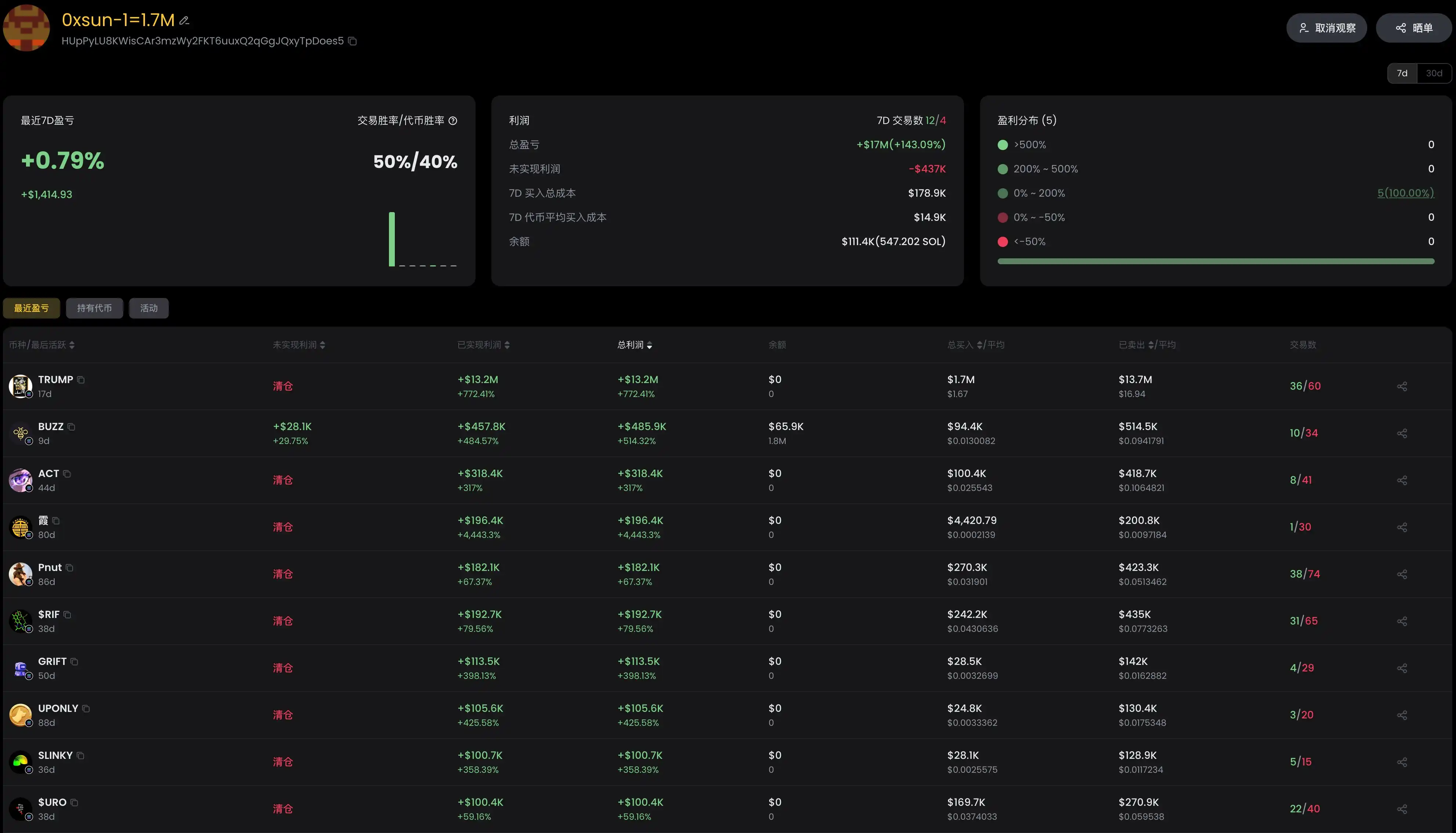
As for whether GMGN or Debot is better, my suggestion is to use both together, cross-reference them, and guard against data omissions or errors from a single tool affecting the analysis.
Five, Monitoring
After identifying the KOL's addresses and conducting data analysis, we need to categorize each address with tags and then use tools to monitor these addresses. This way, when they have transactions, we can know immediately, ahead of social media and Twitter.
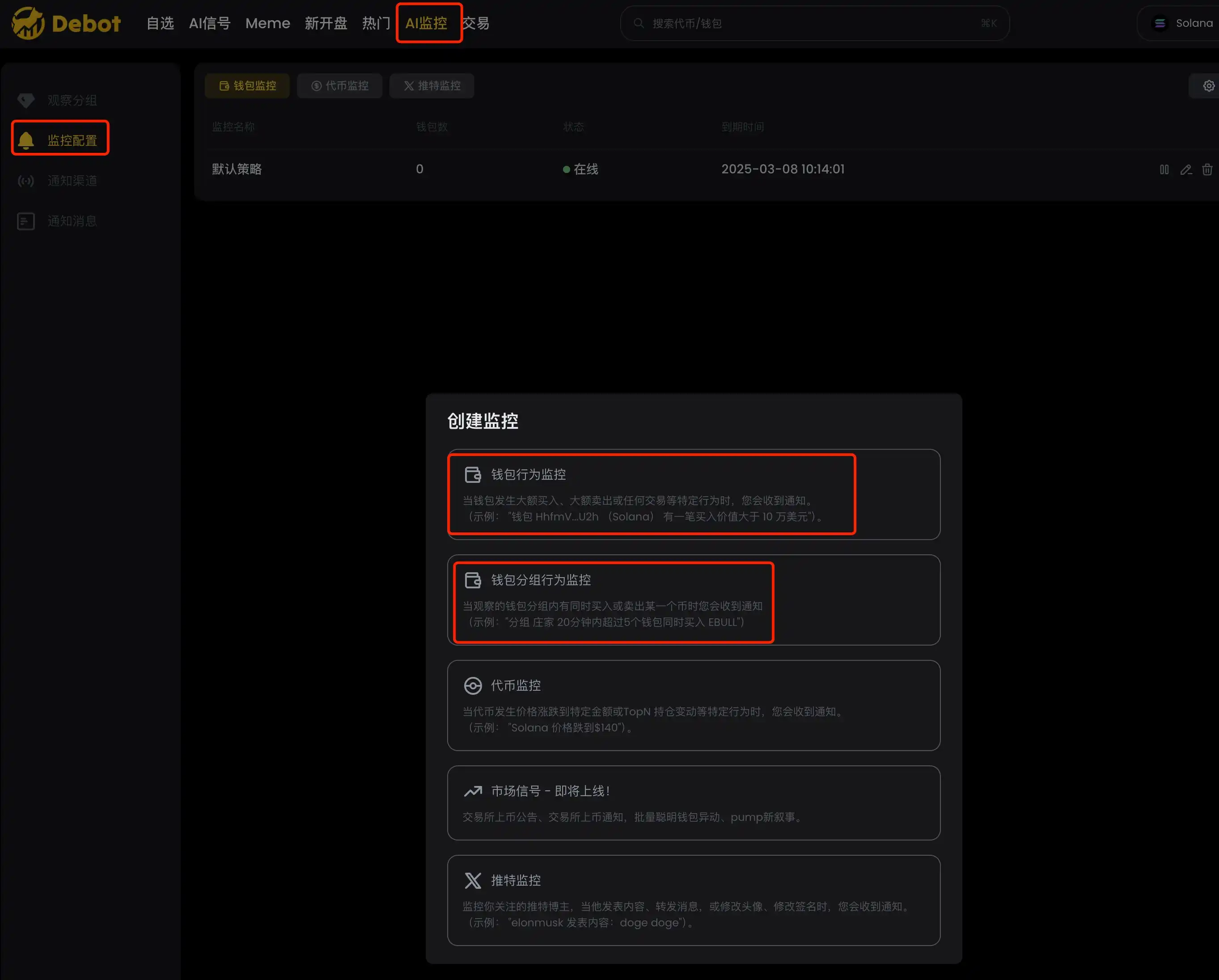
For monitoring, Debot is highly recommended. Debot is currently the most feature-rich and detailed monitoring product I have used, with strong AI signals and smooth transactions.
Debot's wallet monitoring is divided into two types: wallet behavior monitoring and wallet group behavior monitoring, as shown in the image
1. Wallet Behavior Monitoring
This monitoring is a common feature in all tools. However, in other tools, all addresses are pushed to a single Telegram group. The advantage of debot is that it can group addresses and then push notifications to different Telegram groups based on the grouping, as shown in the image.
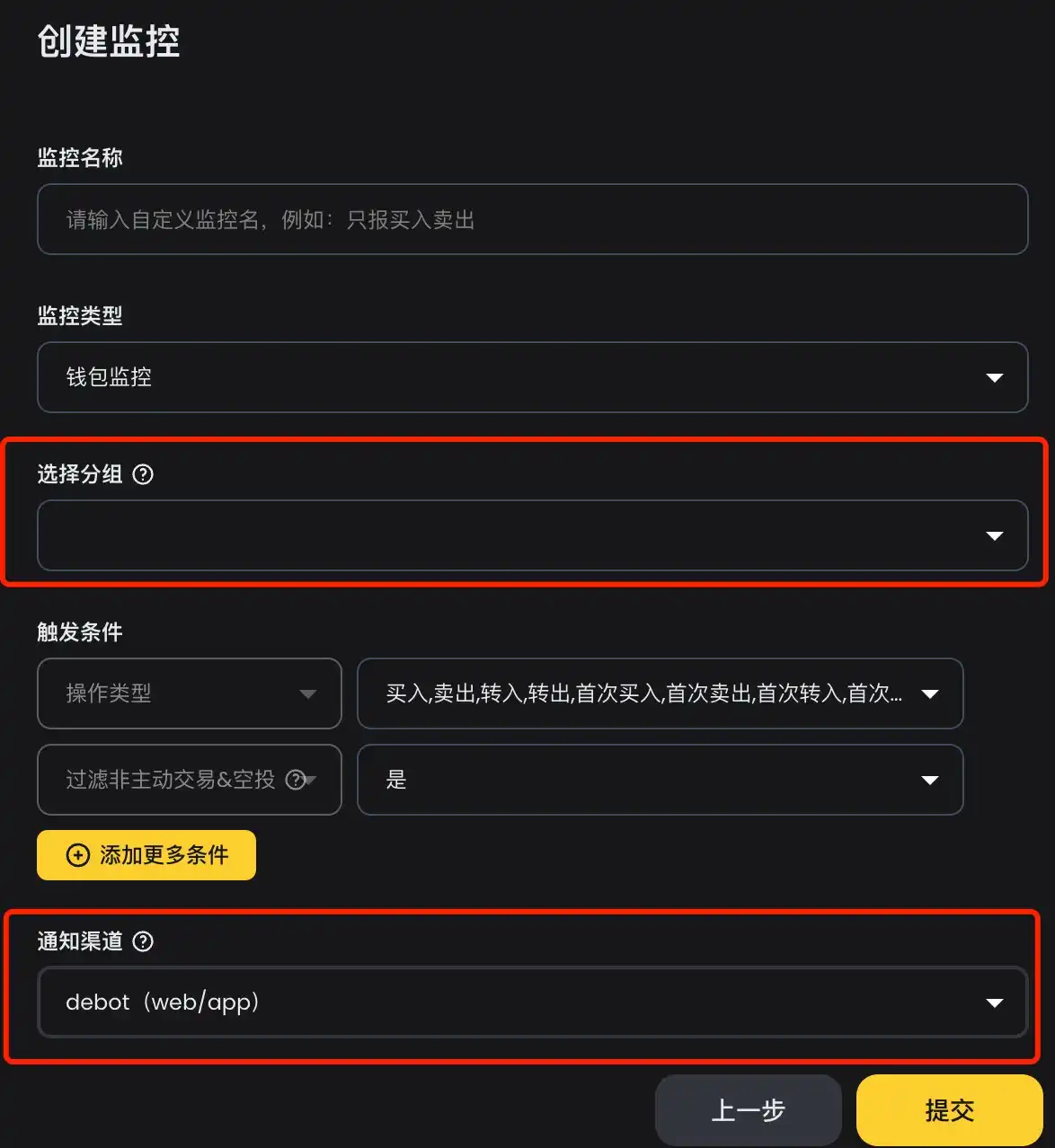
This allows for the establishment of different Telegram groups for monitoring based on tagging, such as addresses from internal exchange users, external exchange users, or addresses of special interest. A tool that can classify monitoring information is a good tool. When I used abot for monitoring before, to achieve grouped notifications, I had to tag the addresses first, and then the Telegram group would receive the monitoring messages, which required additional development to distribute them based on the tags. Now, with debot, I no longer need to do additional development.
2. Wallet Group Behavior Monitoring
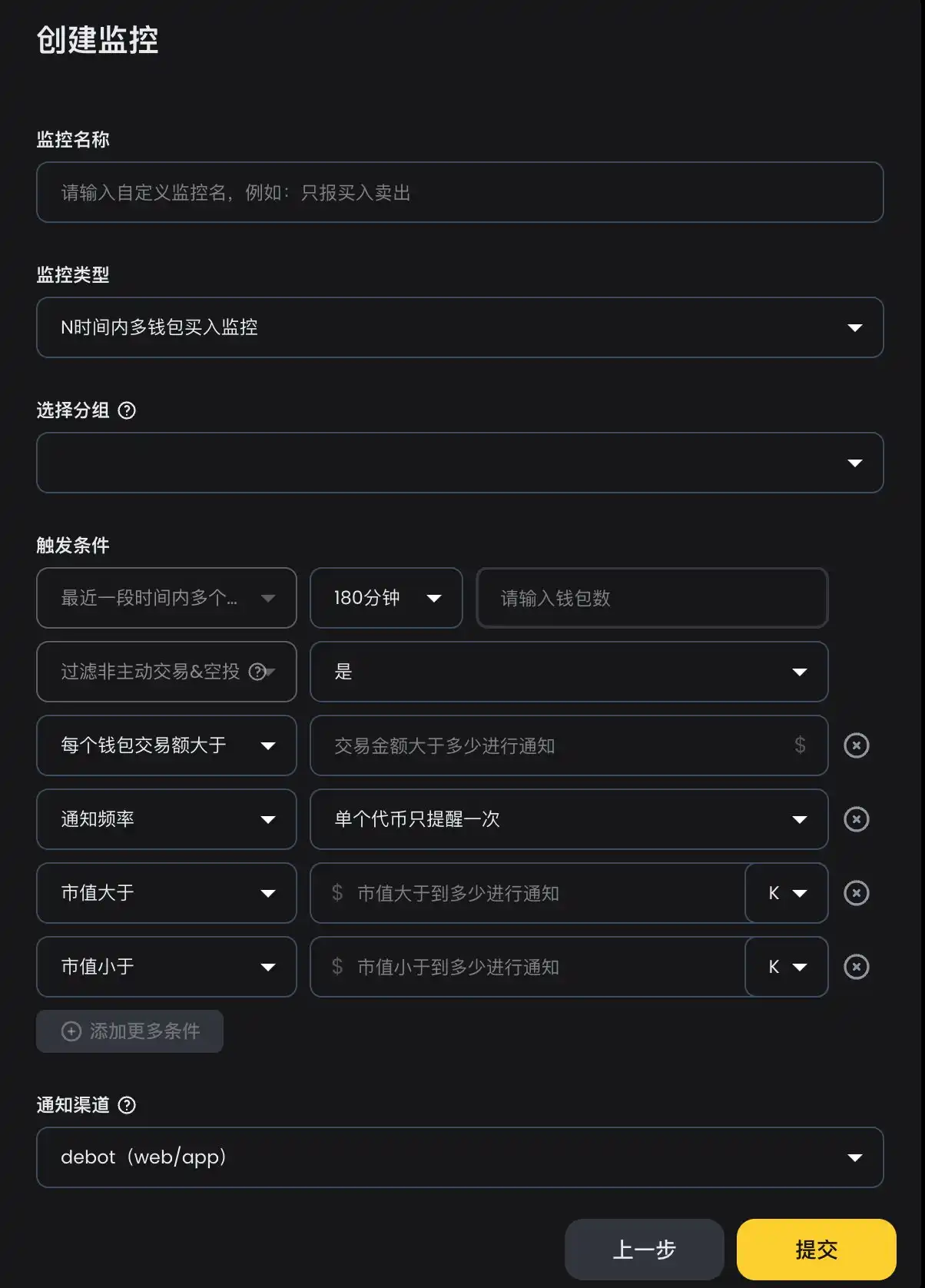
If we are monitoring a large number of addresses, we face an unavoidable issue: excessive notifications. When there are too many messages, it can overwhelm the human brain and lead to information overload, defeating the purpose of monitoring. To address this issue, my previous strategy was to develop notifications further by setting criteria such as only sending notifications when a certain number of different addresses have made transactions within a specific time frame, for example, if 5 different addresses have made purchases within 30 minutes, then send a notification. I used this strategy for about a year, and it was very effective in reducing unnecessary messages while ensuring important updates were not missed.
debot's wallet group behavior monitoring perfectly implements the strategy I mentioned above, but in a more refined way with finer granularity, as shown in the image. We can monitor based on buying and selling, set monitoring time frames, transaction amounts, notification frequencies, and market cap sizes. This feature can fully meet various monitoring needs, and I highly recommend it.
VI. List of Top 100 KOL Addresses
Using the method mentioned above, I have compiled a list of nearly 100 KOL addresses, as shown in the image.
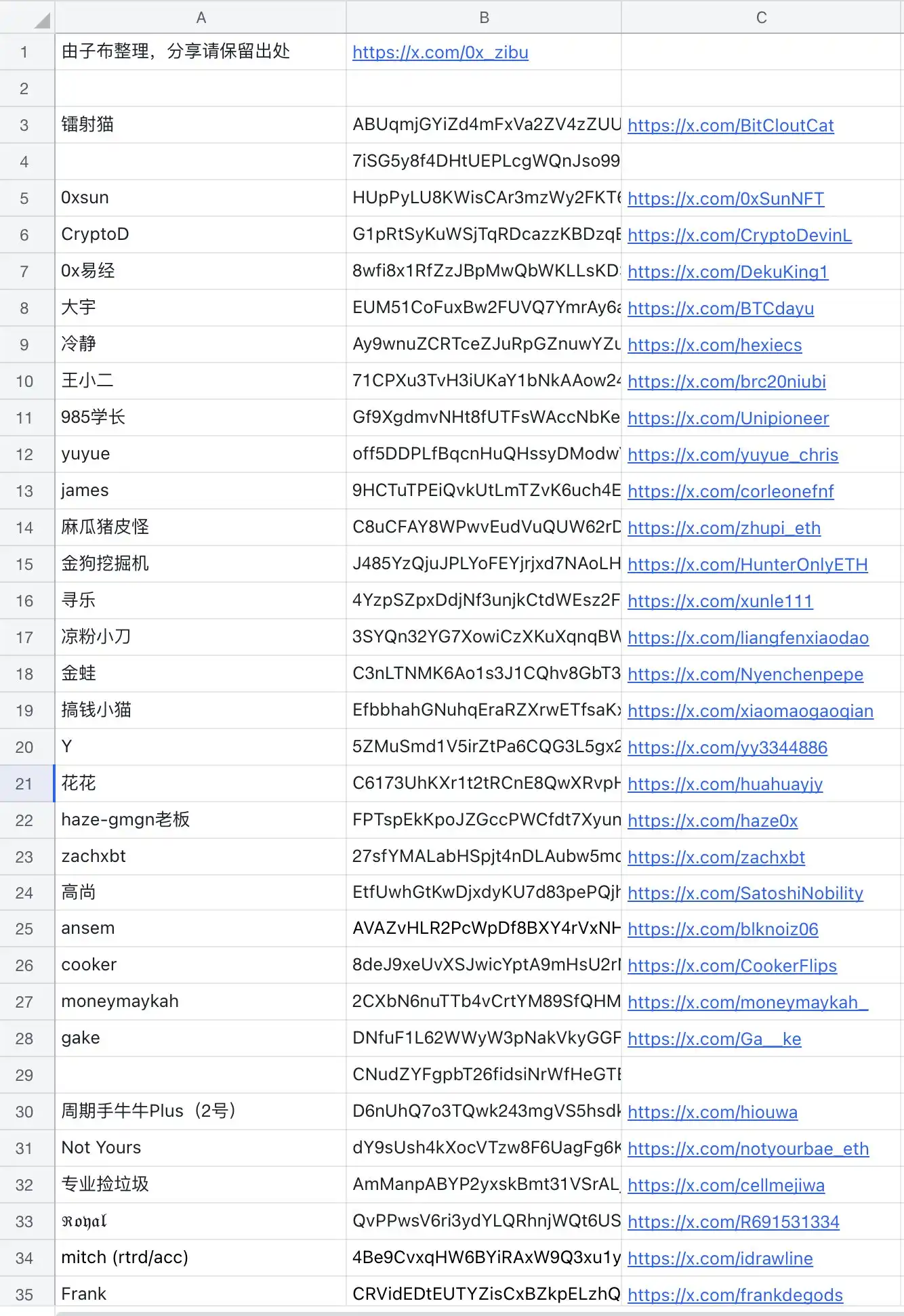
Everyone can analyze and tag each address based on the method described in the fourth section to identify addresses that align with their preferences for monitoring.
The file is uploaded on my Telegram channel and can be downloaded here: https://t.me/zibutalk/79
When sharing this file, please remember to give credit!
7. Summary
The above content introduced the method of finding KOL addresses, and also explained how to analyze and monitor addresses. For KOL addresses that are not included in the file, everyone can use the method above to find them. In addition, the address KOL presents publicly is just one of the addresses they use. Each person has multiple addresses, so you can find their associated addresses based on the above address and collect them to enrich your address database.
Each KOL has a different style, and some KOLs may even rug pull. Everyone should not blindly trust a KOL's address but should choose the one that suits them.
You may also like

WEEX Labs Lands at Dutch Blockchain Week: A Disruptive Crypto × AI Conversation Sets Sail in Amsterdam

SK Hynix Reportedly Plans U.S. ADR Listing as Early as August, With SEC Approval Possible in Late June
SK Hynix may pursue a U.S. ADR listing as early as August, with SEC approval reportedly possible in late June amid strong AI chip supply chain demand.

SpaceX vs Tesla vs xAI: Which Elon Musk Trade Has the Biggest Upside in 2026?

OpenAI Reveals It Has Confidentially Submitted an S-1 to the SEC, Keeping the Door Open for a Future IPO
On June 9, according to an OpenAI announcement, the company recently confidentially submitted a draft S-1 registration statement to the U.S. Securities and Exchange Commission (SEC), beginning the preliminary compliance process for a potential initial public offering. OpenAI said it chose to disclose this proactively because it expected the news might leak; however, the company has not yet set a specific listing timeline, and related arrangements may still take some time.

Latest research from 13 top universities including Cornell University: The current state, challenges, and misconceptions of the fusion of Crypto and AI
Deconstructing Anthropic: The Best AI Company, Possibly Also a Type of Organizational Invention
Apollo and Blackstone Reportedly Back $35 Billion Anthropic Chip Financing as Deal Details Remain Unclear
On June 9, according to currently available news alerts, Apollo and Blackstone Group participated in a $35 billion financing for an Anthropic “chip project.” Based on the original wording of the report, the funding has already been raised, but public information remains limited. The financing structure, use of proceeds, project entity, and whether Apollo and Blackstone participated through equity, debt, or project financing have not yet been disclosed.

Humanity Protocol Security Incident Escalates: More Than $31 Million Stolen From Related Addresses as Attacker Continues Selling H for ETH
On June 9, according to monitoring by Onchain Lens, more than $31 million has been stolen from addresses linked to Humanity Protocol, and the attack is still ongoing, with the hacker continuously swapping H tokens for ETH. Project founder Terence Kwok later confirmed the security incident on X, saying the issue involved a private key leak.

Bloomberg: As Bitcoin Weakens, Stablecoins and RWA Continue to Drive Expansion in Crypto Businesses
In June, Bloomberg reported that despite Bitcoin falling below $60,000 last week, wiping out about $235 billion in market value within seven days, and dropping close to 50% from last year’s peak, some core businesses in the crypto industry are still expanding, mainly in stablecoins, real-world asset tokenization (RWA), payments, and infrastructure. The report also noted that overall altcoin activity has contracted significantly: altcoin market capitalization has fallen from a peak of about $431 billion in November 2021 to around $170 billion, and among the tens of millions of tokens issued in recent years, fewer than 1,700 still maintain meaningful trading activity.

Galaxy Deep Research Report: How Hyperliquid's HIP-4 Upgrade Changes the Landscape of Prediction Markets?
Binance Research: RWA Market Expected to Expand Nearly 6x from Early 2025, with Public Equities and Onchain Payments Heating Up Together
In June, Binance Research said in its monthly market report that the real-world asset (RWA) market is expected to grow by about 589% from the beginning of 2025. Bond- and money market fund-related RWA expanded by about $6.5 billion, up 83% year over year, while publicly traded equity RWAs grew by about 422%. The report also noted that monthly crypto debit card transaction volume exceeded $747 million in May, up 48.6% year to date.

Japan to Assess a Framework for Yen Stablecoins and Crypto ETFs as Asia’s Compliant Payments Narrative Heats Up
Recently, according to the original report, Japan is considering the launch of yen stablecoins and cryptocurrency ETFs. Public information remains limited at this stage, and there is still no complete policy text, regulatory draft, or clear implementation timeline, so this is better characterized as a “policy discussion” rather than formal implementation. The original wording also noted that advancing stablecoin regulation in Asia is driving XRP usage and supporting growth in the XRPL ecosystem. However, based on currently available public information, there is not enough evidence to directly establish a clear causal relationship between this round of discussion in Japan and XRP or XRPL.

ZachXBT: Humanity private key leak and abnormal surge in H token should be viewed separately
On June 9, according to related disclosures, on-chain investigator ZachXBT posted an update on Humanity’s roughly $31 million security incident, saying that after further analyzing fund flows, he currently tends to believe the project team was not involved in an “inside job” or a self-staged attack. According to him, the official explanation about the private key leak was broadly accurate, but before the token unlock, the price of H had been artificially pushed higher, and the hacker later took advantage of that market environment; therefore, the private key leak and the earlier abnormal price pumping should be regarded as two separate and independent events. This reframing has shifted the market’s understanding of the nature of the incident. Earlier discussion around Humanity had focused on whether the team directly participated in the attack or used the security incident to cover up internal operations. ZachXBT’s latest remarks shift the focus from “whether it was self-theft” to “whether there were pre-unlock market structure issues.” He also questioned whether the team may have.

Morning Report | OpenAI has submitted an S-1 registration statement draft to the U.S. SEC; Morpho completes $175 million financing

Morning Report | BitMine increased its holdings by 126,971 ETH last week; trader Eugene announced his exit from the crypto market

Wang Chuan: How can one not feel anxious after the neighbor Old Wang made thirty times profit by investing in storage stocks? (Seven) - A quarter-century cycle
Cryptocurrency CEXs are flocking to sell US stocks, and traditional brokerages are facing an "uninvited guest."
$75 billion in foreign capital has fled, and South Korean retail investors have absorbed it all using leverage
WEEX Labs Lands at Dutch Blockchain Week: A Disruptive Crypto × AI Conversation Sets Sail in Amsterdam
SK Hynix Reportedly Plans U.S. ADR Listing as Early as August, With SEC Approval Possible in Late June
SK Hynix may pursue a U.S. ADR listing as early as August, with SEC approval reportedly possible in late June amid strong AI chip supply chain demand.
SpaceX vs Tesla vs xAI: Which Elon Musk Trade Has the Biggest Upside in 2026?
OpenAI Reveals It Has Confidentially Submitted an S-1 to the SEC, Keeping the Door Open for a Future IPO
On June 9, according to an OpenAI announcement, the company recently confidentially submitted a draft S-1 registration statement to the U.S. Securities and Exchange Commission (SEC), beginning the preliminary compliance process for a potential initial public offering. OpenAI said it chose to disclose this proactively because it expected the news might leak; however, the company has not yet set a specific listing timeline, and related arrangements may still take some time.
Latest research from 13 top universities including Cornell University: The current state, challenges, and misconceptions of the fusion of Crypto and AI
Deconstructing Anthropic: The Best AI Company, Possibly Also a Type of Organizational Invention


