
USDT Savings offers a yield of over 90%. When is Kamino's next PYUSD snapshot?




The series of fluctuations since the beginning of 2025 has caused the market to react with ups and downs. The peak of the bull market has been reached, even becoming market consensus. During the Lunar New Year, the cryptocurrency panic and greed index has remained in the 60-70 range, with market greed sentiment cooling compared to the end of last year. On the other side of the market, the total market value of stablecoins across all chains has surpassed $217 billion, hitting a historical high, and this rapid growth naturally cannot be separated from the Trump factor. Since the release of the TRUMP token on January 18, there has been a surge in on-chain incremental users, leading Solana to surpass BNB Chain and become the third-largest blockchain network in stablecoin supply.
The market continues to decline, and participants now have a stronger demand to counter risks and seek stable returns. For DeFi users, stablecoins not only serve as a hedge against market volatility but have also gradually evolved into a "striving for stability" financial track. The rapid expansion of stablecoin applications in the Solana ecosystem has provided participants with more diversified investment strategies and more potential return opportunities. Next, we will take Kamino, the leading lending protocol on Solana, as an example to explore its new trends and high-yield opportunities in the stablecoin financial field.
USDT's Financial Returns Reach Up to 90%, Kamino's Ace Goes Beyond This
Kamino Finance was founded in 2022 and is a DeFi protocol with various functions such as lending, automated liquidity pools, compounding, leverage, and trading. Currently, on Solana, Kamino's TVL ranks fourth behind Jito, Jupiter, and Raydium. Recently, Kamino has also launched a Beta test of the Swap feature, with TVL and fee income hitting record highs.
Moreover, Kamino occupies a leading position in various asset categories in the Solana ecosystem, including PYUSD and the recent cbBTC. 88% of the cbBTC on the Solana chain has been deposited into Kamino.
In August last year, Kamino launched the PYUSD incentive plan, which successfully attracted $180 million in PYUSD inflows. As the demand for PYUSD lending grew, these inflows eventually translated into a source of income for the protocol.
Related Reading: "With an Annualized Rate of Over 10%, Why Does PayPal's Stablecoin Offer Such High Returns on Kamino Finance?"
Likewise, for stablecoins, Kamino recently launched a USDT-related incentive program. For example, USDT lending was introduced in the JLP Market and Main Market, and the Yield Booster Market also launched a USDT JLP Multiply section, with a yield of nearly 90%. It is well known that Solana has always been USDC's stronghold, but now the largest borrowing protocol on Solana has started incentivizing USDT, which can be seen as a positive signal.
Leverage Strategy Boosts Returns with "Multiplication"
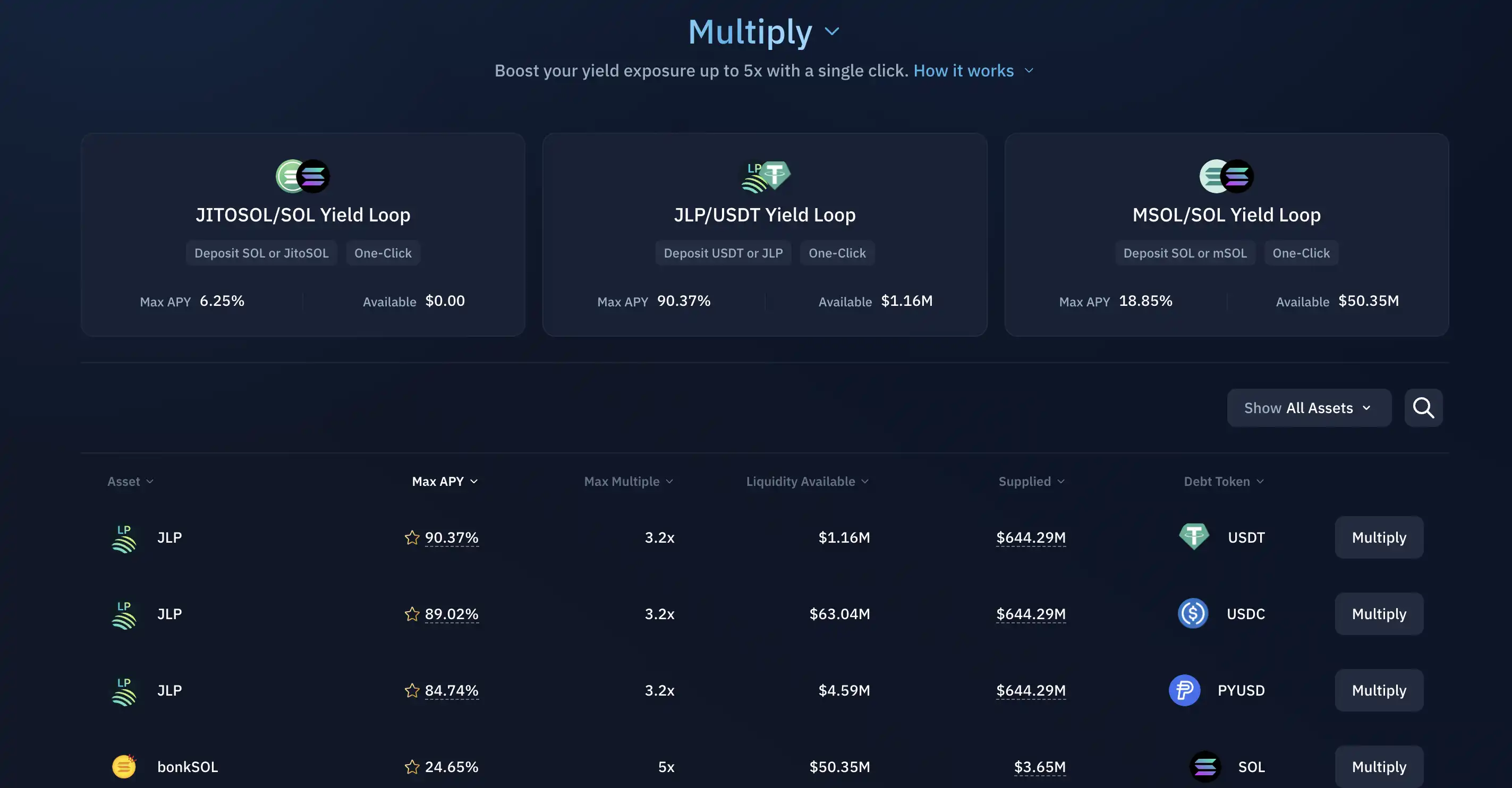
If you have idle USDT, a low-risk way to participate is to provide USDT in Kamino's lending market. Currently, the APY for USDT in the Main Market and JLP Market is 6% and 5%, respectively. However, you can also choose to deposit USDT into Kamino's flagship Multiply module, where the highest APY can reach 90%.
Compared to conventional lending products, Multiply combines liquidity staking, flash loans, and lending protocols to provide a leverage strategy that further amplifies returns. Users can collateralize some assets, and the protocol automatically borrows more assets to reinvest in the liquidity pool, using a capital-efficient loop to achieve returns several times higher than the principal. This process relies on K-Lend's two core mechanisms: eMode and flash loans.
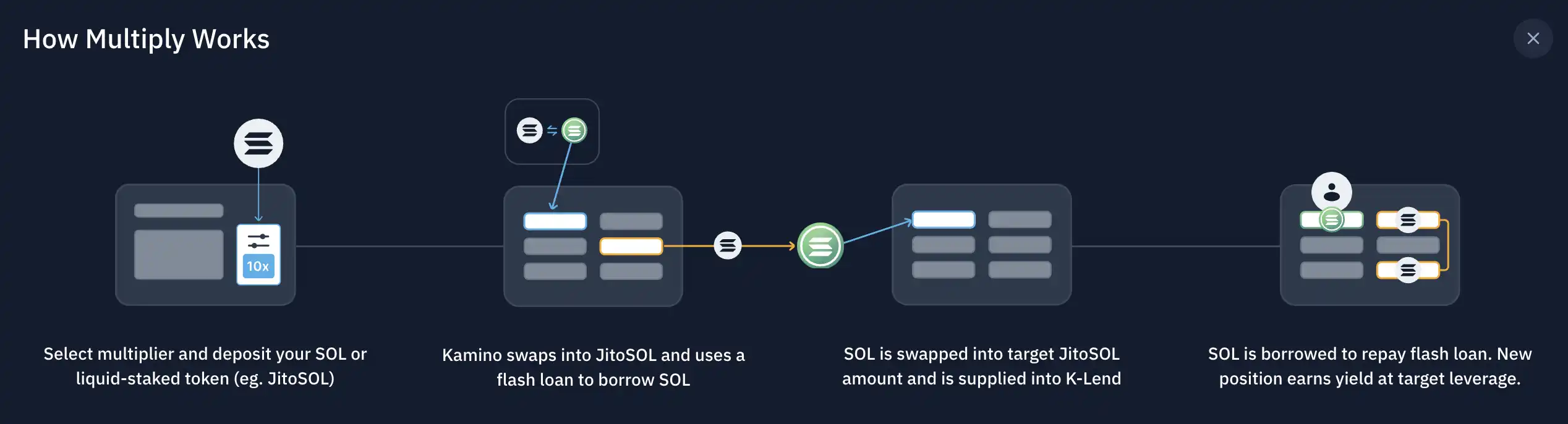
For example, a user selects the leverage multiplier they wish to use and deposits assets such as SOL or JitoSOL. At the protocol level, Kamino automatically converts the user's deposited SOL into JitoSOL. To further enhance the user's capital efficiency, Kamino will also borrow SOL via flash loans. The borrowed SOL is converted into more JitoSOL, which is then deposited into Kamino's lending platform, K-Lend. Subsequently, Kamino borrows SOL from K-Lend to repay the earlier flash loan.
However, for the user, they only need to deposit assets and select the leverage multiplier. The end result is that the user holds a leveraged position, with the yield exposure amplified to the target multiplier. The returns and costs of this position are as follows:
Staking Yield: As JitoSOL serves as the liquidity staking token, it continuously generates SOL staking rewards at the JitoSOL staking APY.
Lending Cost: Users need to pay the borrowing APY in SOL, which is the cost of using leverage.
Net Yield: As long as JitoSOL's staking APY is higher than SOL's borrowing APY, users can achieve a positive yield. For example, if JitoSOL's staking APY is 7%, and SOL's borrowing APY is 6%, then the user's net yield is 1%.
Currently, Kamino's Multiply product offers over a dozen options, but the highest-ranking in terms of maximum annual yield are all stablecoin-related JLP Multiply, with USDT's maximum APY exceeding 90%.
Ecosystem Depth + Automation: Sustainability Behind High Yield
The yield and sustainability of DeFi projects have always been a core concern for investors, but relying solely on short-term high returns to attract users is not sustainable. Especially in the current market environment, many platforms that rely on subsidies or platform token incentives may offer high short-term returns, but these returns are often unstable and difficult to sustain in the long term.
In contrast, Kamino demonstrates greater sustainability through its unique ecosystem depth and automated management mechanism.
Kamino does not rely solely on short-term yield incentives, but through deep involvement in the Solana ecosystem, it provides a more stable and long-term source of income. This model not only attracts more long-term investors but also brings more stable liquidity to the platform. By deeply integrating with mainstream protocols in the Solana ecosystem, such as Jupiter and Jito, Kamino achieves more efficient asset management and yield optimization.
For example, taking the JTO-JITOSOL Treasury as an example, starting from January 6, 75,000 JTO tokens are distributed through Kamino to depositors as incentives, and these rewards will be distributed in proportion to TVL just like other Kamino farms. For instance, if you hold 10% of the treasury in the next 30 days, you will receive a 10% JTO reward.
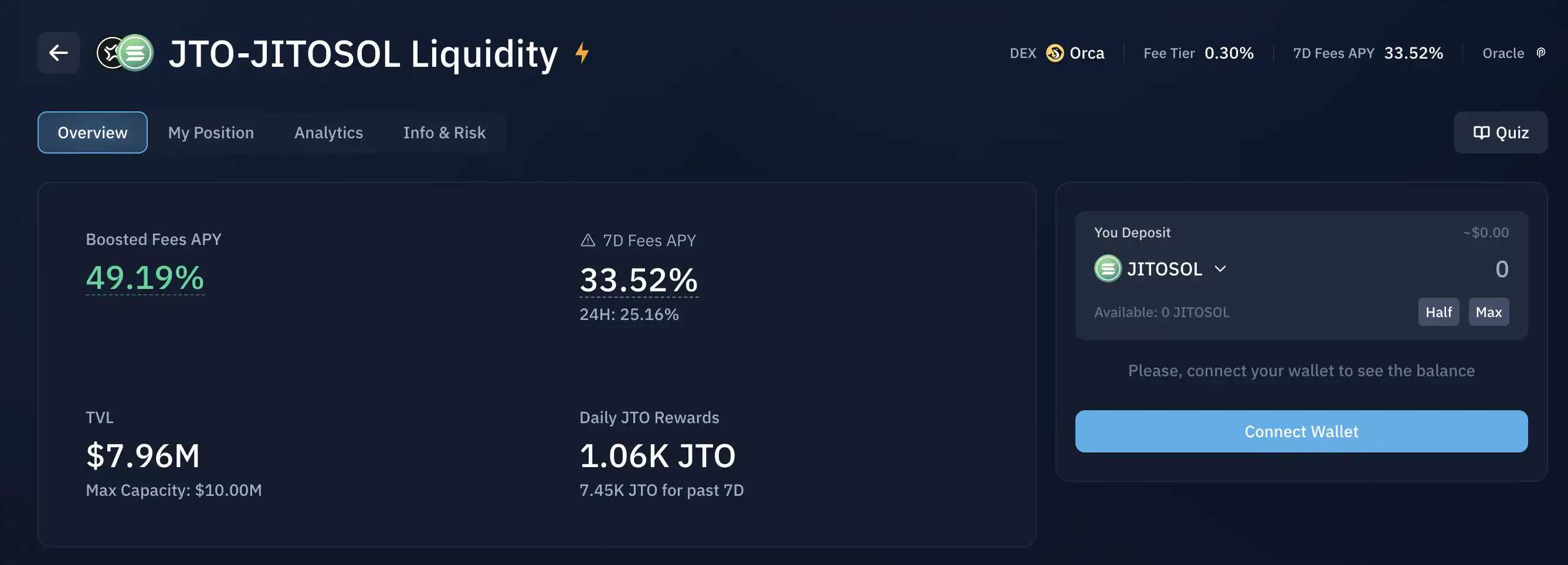
In addition, users depositing in the treasury can also receive MET points from the Solana ecosystem DEX Meteora and Warchest points from the Kyros staking protocol, in order to participate in airdrops from projects in the Solana ecosystem that have not yet conducted Token Generation Events (TGE).
Automation is another key feature of Kamino, in addition to the Multiply mentioned earlier, there is also automated liquidity treasury. This was the first product launched by Kamino in August 2022, which injects users' funds into the underlying DEX liquidity pool and optimizes returns through automation tools. Specifically, when a user deposits funds into the Kamino treasury, these funds are allocated to a DEX liquidity pool composed of two tokens. Whenever a trader uses this liquidity pool for token exchange, a certain fee is generated, and as a Kamino depositor, users can earn a share of these transaction fees.
The automation technology is reflected in Kamino's automatic adjustment of users' positions, ensuring that the funds are always in the optimal trading range to maximize returns and reduce impermanent loss risk. Furthermore, Kamino will automatically reinvest transaction fees and additional incentives into users' positions, without the need for manual user operations, further enhancing the efficiency of fund utilization. Kamino also supports automatic conversion of one-sided deposits and withdrawals, streamlining the user's operation process.
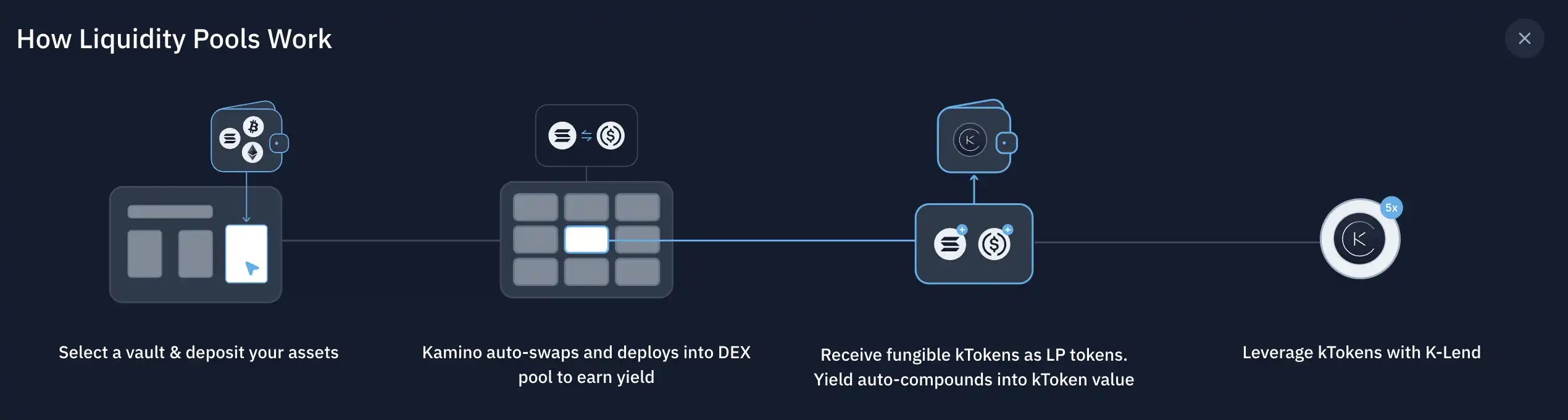
To enhance user flexibility, Kamino also provides an interchangeable kToken as a deposit certificate. After depositing funds, users can freely use kToken in the DeFi ecosystem for other operations, further unlocking the value of the funds.
“Road to $10B”: Kamino's Vision for the Future
As the Solana ecosystem expands, the number of projects, types of assets, and user base continue to grow, and the demand for the lending market is also increasing in sync. In July 2024, Kamino released a phased growth strategy plan "Kamino: Road to $10B," mentioning the development of four core pillars, including product, community, native token, and revenue. The latter three are temporarily set aside. To survive in the competitive crypto market, having a core product is the most powerful moat.
Currently, the credit market in the Solana ecosystem still relies mainly on large, centralized lending pool models, but there is still huge room for development, bringing many new opportunities. For Kamino, the most anticipated V2 update will introduce modular lending, further evolving Kamino Lend to make it a more powerful, more open lending infrastructure. The launch of V2 will give rise to a series of innovative products and enable the protocol to cover entirely new use cases, such as:
RWA Lending
P2P Lending
Order Book-based Lending
Advanced Risk Management Engine
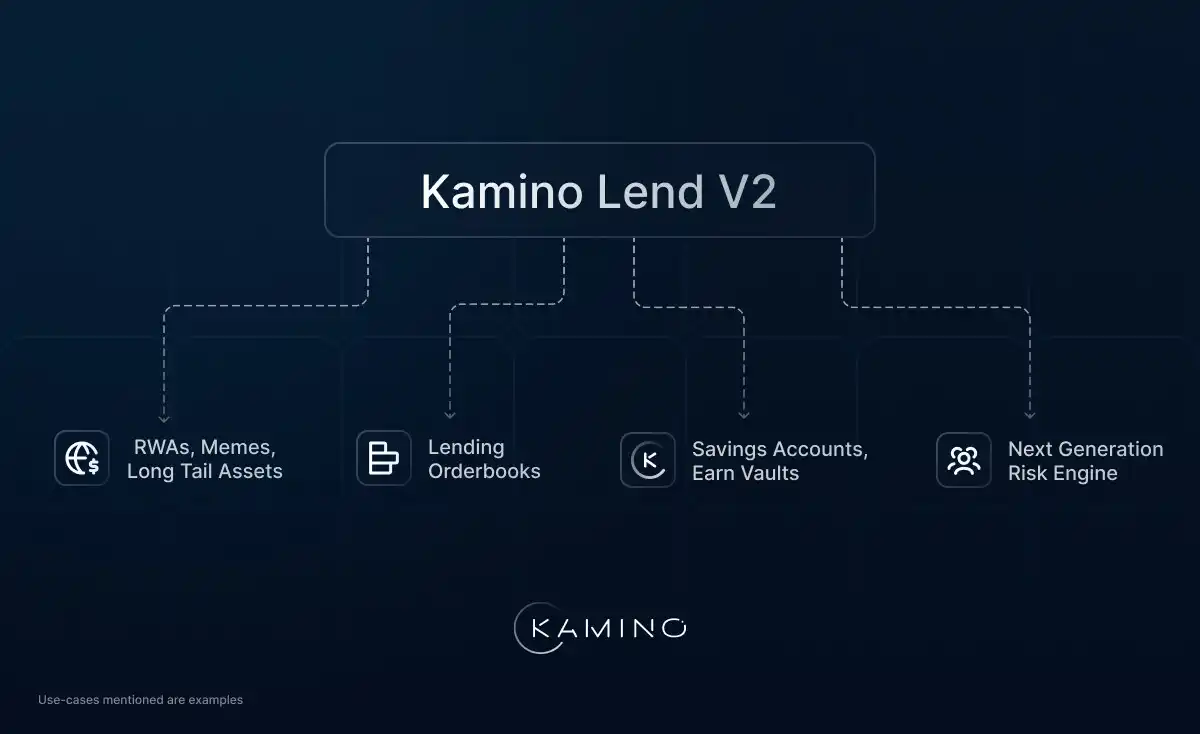
In addition to modular lending, Kamino V2 will also introduce spot leverage, improve its liquidation engine and risk management, and provide features such as automatic collateral cancellation, target leverage, and stop loss/take profit.
V2 will also further deepen its ties with Solana's ecosystem projects. Currently, Kamino is in deep discussions with multiple DeFi protocols, all of which will innovate and explore new use cases based on V2. Partners include existing Solana ecosystem projects as well as non-native projects migrating to Solana, all of which will launch core products on Kamino Lend V2.
According to the official documentation, Kamino is also internally incubating multiple V2 ecosystem projects and will invest heavily in the following areas:
DeFi protocol integrations (driving more DeFi protocols to interoperate with V2)
Ecosystem Integration Grants (supporting developers to build V2-based products)
Hackathon Sponsorships (attracting more developers to join the V2 ecosystem)
Currently, the Solana DeFi landscape has achieved a certain level of stability, with stablecoin share growing by 112% this year. As a lending leader, Kamino still has a high ceiling for development. Whether it can continue to expand steadily with its unique technological and ecosystem advantages is also worth the market's close attention. After all, in the ever-changing crypto industry, seizing the next growth point could become a new "breakout engine."
You may also like

Kalshi Executive Challenges “SBF Backed AI Unicorns” Narrative, Says Leopold Aschenbrenner Was Key Figure
Kalshi executive John Wang questioned the “SBF backed AI unicorns” narrative, saying Leopold Aschenbrenner was the key figure behind major AI investment decisions.

Pantera Capital Partner: How Tokenization is Restructuring the Private Equity and Early Investment Ecosystem?

New York Proposes Stricter Stablecoin Issuer Rules Aligned With Federal GENIUS Act
NYDFS proposed stricter stablecoin issuer rules aligned with the GENIUS Act, covering reserves, custody, redemption timelines, audits, and capital buffers.
Every exchange is a "Universal Exchange."

The counterattack of traditional finance: Alliance chains are quietly reviving

CryptoQuant Says Bitcoin Profitable Supply Is Near 45% Pressure Zone as On-Chain Data Points to Market Repricing
CryptoQuant said Bitcoin’s profitable supply is nearing the 45% pressure zone, signaling rising market stress, unrealized losses, and a possible on-chain repricing phase.

Bitcoin Falls Below 200-Week Moving Average as On-Chain Data Shows Over Half of Supply in Loss
Bitcoin dropped below its 200-week moving average as on-chain data showed over 50% of circulating supply is now in loss, signaling rising market stress.

CFTC Reportedly Plans New Prediction Market Rules Focused on Manipulation Risk and Public Interest Review
The CFTC is reportedly preparing new prediction market rules focused on manipulation risk, public interest review, and retail trader protections.

Meet the new WEEX trial fund—your gateway to greater profits

WEEX Labs Lands at Dutch Blockchain Week: A Disruptive Crypto × AI Conversation Sets Sail in Amsterdam

SK Hynix Reportedly Plans U.S. ADR Listing as Early as August, With SEC Approval Possible in Late June
SK Hynix may pursue a U.S. ADR listing as early as August, with SEC approval reportedly possible in late June amid strong AI chip supply chain demand.

SpaceX vs Tesla vs xAI: Which Elon Musk Trade Has the Biggest Upside in 2026?
OpenAI Reveals It Has Confidentially Submitted an S-1 to the SEC, Keeping the Door Open for a Future IPO
On June 9, according to an OpenAI announcement, the company recently confidentially submitted a draft S-1 registration statement to the U.S. Securities and Exchange Commission (SEC), beginning the preliminary compliance process for a potential initial public offering. OpenAI said it chose to disclose this proactively because it expected the news might leak; however, the company has not yet set a specific listing timeline, and related arrangements may still take some time.

Latest research from 13 top universities including Cornell University: The current state, challenges, and misconceptions of the fusion of Crypto and AI
Deconstructing Anthropic: The Best AI Company, Possibly Also a Type of Organizational Invention
Apollo and Blackstone Reportedly Back $35 Billion Anthropic Chip Financing as Deal Details Remain Unclear
On June 9, according to currently available news alerts, Apollo and Blackstone Group participated in a $35 billion financing for an Anthropic “chip project.” Based on the original wording of the report, the funding has already been raised, but public information remains limited. The financing structure, use of proceeds, project entity, and whether Apollo and Blackstone participated through equity, debt, or project financing have not yet been disclosed.

Humanity Protocol Security Incident Escalates: More Than $31 Million Stolen From Related Addresses as Attacker Continues Selling H for ETH
On June 9, according to monitoring by Onchain Lens, more than $31 million has been stolen from addresses linked to Humanity Protocol, and the attack is still ongoing, with the hacker continuously swapping H tokens for ETH. Project founder Terence Kwok later confirmed the security incident on X, saying the issue involved a private key leak.

Bloomberg: As Bitcoin Weakens, Stablecoins and RWA Continue to Drive Expansion in Crypto Businesses
In June, Bloomberg reported that despite Bitcoin falling below $60,000 last week, wiping out about $235 billion in market value within seven days, and dropping close to 50% from last year’s peak, some core businesses in the crypto industry are still expanding, mainly in stablecoins, real-world asset tokenization (RWA), payments, and infrastructure. The report also noted that overall altcoin activity has contracted significantly: altcoin market capitalization has fallen from a peak of about $431 billion in November 2021 to around $170 billion, and among the tens of millions of tokens issued in recent years, fewer than 1,700 still maintain meaningful trading activity.
Kalshi Executive Challenges “SBF Backed AI Unicorns” Narrative, Says Leopold Aschenbrenner Was Key Figure
Kalshi executive John Wang questioned the “SBF backed AI unicorns” narrative, saying Leopold Aschenbrenner was the key figure behind major AI investment decisions.
Pantera Capital Partner: How Tokenization is Restructuring the Private Equity and Early Investment Ecosystem?
New York Proposes Stricter Stablecoin Issuer Rules Aligned With Federal GENIUS Act
NYDFS proposed stricter stablecoin issuer rules aligned with the GENIUS Act, covering reserves, custody, redemption timelines, audits, and capital buffers.
Every exchange is a "Universal Exchange."
The counterattack of traditional finance: Alliance chains are quietly reviving
CryptoQuant Says Bitcoin Profitable Supply Is Near 45% Pressure Zone as On-Chain Data Points to Market Repricing
CryptoQuant said Bitcoin’s profitable supply is nearing the 45% pressure zone, signaling rising market stress, unrealized losses, and a possible on-chain repricing phase.


