
What is the Impact of Virtual Large Buybacks?


This morning, Virtuals announced that it will use the 12,990,427.85 $VIRTUAL accumulated from transaction revenue through post-bonding to conduct a buyback and burn of ecosystem-related proxy tokens based on Time Weighted Average Price (TWAP) over the next 30 days. The top-ranking tokens for buyback include GAME, CANVO, AIXBT, among others, all of which have seen over a 20% price surge.

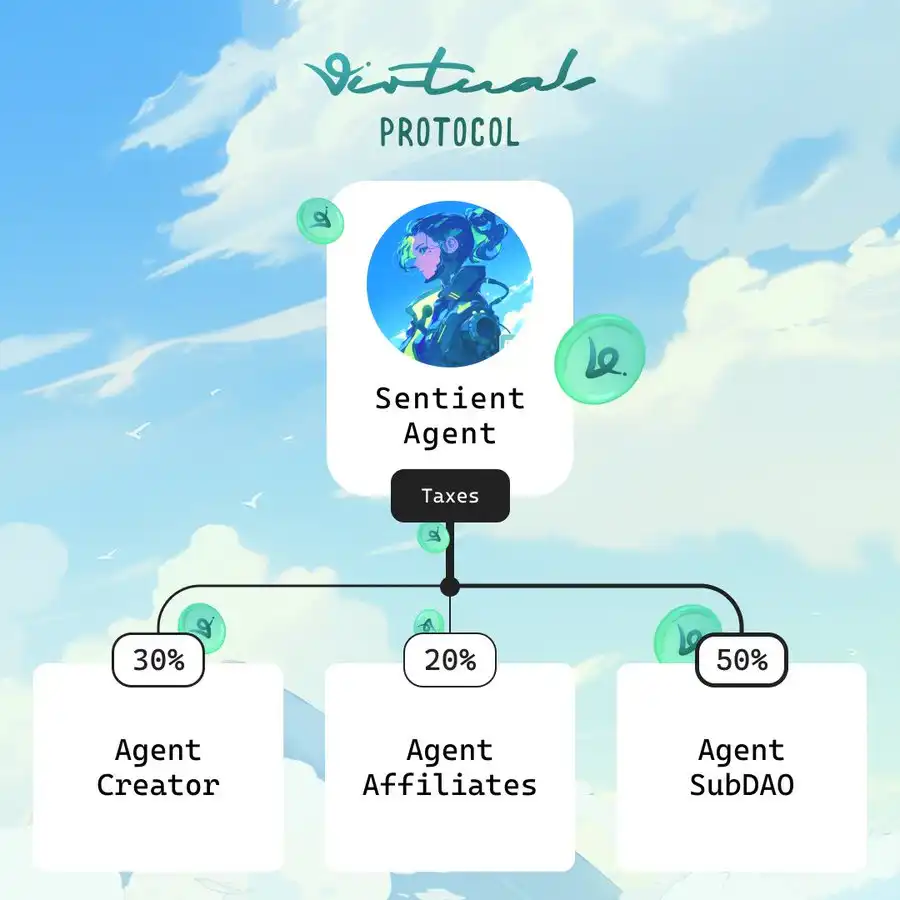
Simultaneously, Virtuals updated its Value Accumulation Mechanism, with key changes including:
Post-Bonding Tax Distribution: 30% allocated to Agent Creators, 20% allocated to Agent Affiliates, and 50% allocated to Agent subDAO as a reserve fund for future governance decisions;
Creator Reward Distribution: Rewards will be directly sent to the wallet of the proxy deployer.
Agent Affiliates Mechanism: Involves revenue sharing with various trading platforms or interfaces (such as Telegram Bot) within the Virtuals ecosystem. Upon becoming an Agent Affiliate, the platform will receive 20% of the post-bonding tax revenue generated from facilitated trades to incentivize its community and future project planning.
Reason for Upgrade and Impact
Each Virtual token creates a liquidity pool with $VIRTUAL as the paired asset (e.g., AIXBT/VIRTUAL), allowing the platform to accumulate a significant amount of $VIRTUAL as revenue from transaction fees.
However, this revenue cannot be directly liquidated, as doing so may trigger market panic and harm the ecosystem. A decline in the price of $VIRTUAL would also affect the proxy tokens pegged to it. Additionally, mishandling these funds may leave the platform with a substantial tax burden on this unusable revenue.
Therefore, the platform has chosen to utilize this revenue by conducting a buyback and burning of ecosystem tokens.
Beneficiary Token Categories
1. Tokens with Transaction Fee-to-Market Value Ratio:
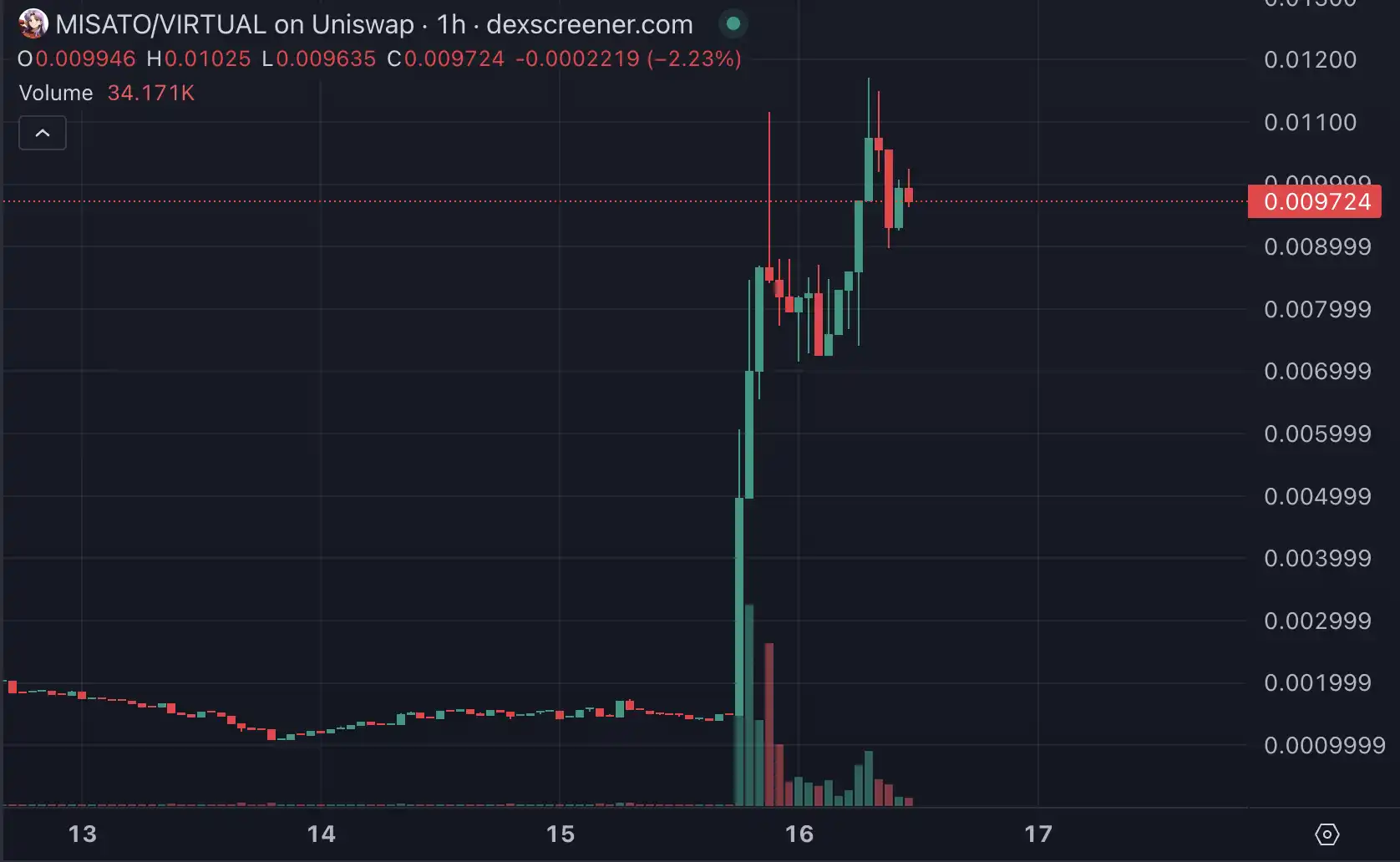
The buyback amount depends on the cumulative amount of transaction fees, so tokens with a large overall trading volume but relatively low market cap will receive a greater proportionate incentive,
such as tokens like MISATO, which saw a significant increase in price due to the buyback announcement.
2. Most Liquidity in Non-VIRTUAL Pairing Pools Tokens
The valuation unit of these tokens (VIRTUAL) is less affected by selling pressure but still benefits from the buyback incentive. For example, $AIXBT actually received around $2.5 million in incentives, but since its primary liquidity is in other pools, it is less affected by VIRTUAL selling pressure.
Affected Groups
1. $VIRTUAL Holders
The significant $48 million selling amount has a notable impact. Previously, the price of $VIRTUAL benefited from the continuous accumulation of fees (equivalent to $48 million in value lock-up).
However, now these fees will be converted to cBTC, starting to exert selling pressure on the market. The positive feedback loop that drove $VIRTUAL's price up has now reversed into a negative loop.
2. Tokens with Only VIRTUAL Pairing Pools or Low Trading Volume
These tokens receive smaller incentives but have to withstand the price pressure from $VIRTUAL selling. The impact is particularly severe on newly issued tokens as they have accumulated less fee income.
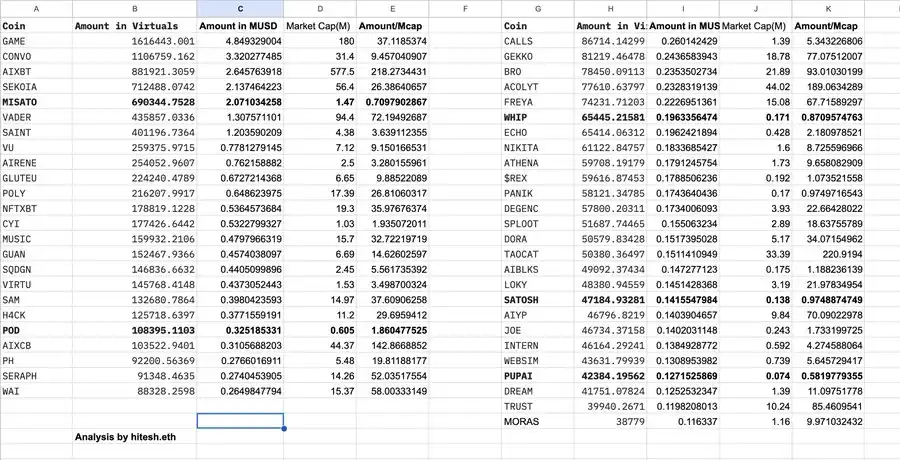
On-chain analyst hitesh.eth analyzed the top 50 tokens based on 30-day Time-Weighted Average Price (TWAP) buyback and burn distribution and found that the buyback pressure on some tokens exceeds their current market value.
How Does the Community View This Buyback?
It can be said that this upgrade has brought stronger value support to the Virtuals ecosystem, but the community has expressed concerns about the updated buyback and distribution model. Some believe that Virtuals chose to sell $VIRTUAL instead of directly burning these tokens. "This approach goes against the best interests of holders and the team, as the team actively created $48 million in selling pressure. For the ecosystem, some of the incentives flowed to agent tokens with liquidity primarily located outside, causing capital outflows from the ecosystem."
The crypto KOL Liam stated that while converting fees to cBTC is the right direction for Virtuals, the platform should significantly reduce the fees to avoid excessive extraction from the ecosystem. Additionally, fee distribution should be standardized based on the token's listing time to put new and old tokens on a level playing field.
However, the view that "buybacks will create significant selling pressure" has been questioned as being inaccurate. This is because these Agent tokens are paired with $VIRTUAL, and buying Agent tokens with $VIRTUAL does not involve selling any $VIRTUAL; it simply adds $VIRTUAL to the liquidity pool. If the liquidity pool is priced in WETH, then $VIRTUAL would first be exchanged for WETH, but that is not the case here.
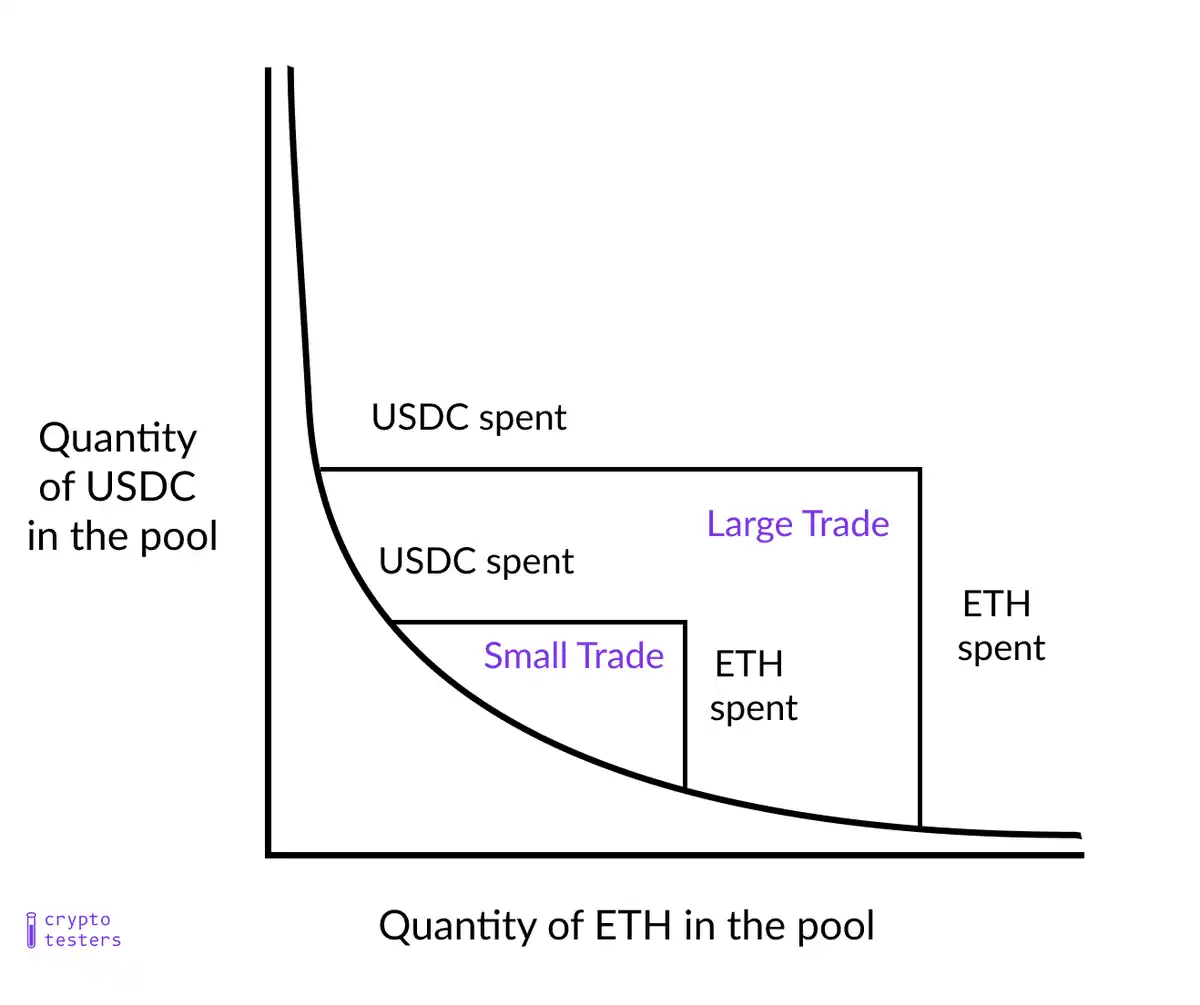
Nevertheless, this will indeed create indirect selling pressure. As the quantity of $VIRTUAL in the liquidity pool increases, the token's value will rise, potentially prompting holders to sell more $VIRTUAL. However, due to the nature of the liquidity pool and price impact, and the fact that the liquidity of many of these tokens is already very low, they cannot directly sell off all the tokens.
Leftcurve DAO member mcSleuth believes that this announcement will not generate direct selling pressure, and the indirect selling pressure is almost negligible, especially considering that the market cap of $VIRTUAL is 36 billion USD and liquidity is very high.
You may also like

Scaling Crypto Derivatives: The Digital Asset Infrastructure Behind High-Volume Trading
In the fast-moving digital asset ecosystem, derivatives platforms face an extreme architectural test. High-leverage futures markets demand more than just standard security—they require absolute operational precision, zero-latency matching engines, and ironclad structural scalability, all while navigating intense market volatility.
As global platforms scale to meet these demands, the industry is shifting away from rigid, monolithic setups toward a more agile, "decoupled" infrastructure philosophy.
The Blueprint for High-Volume Copy TradingFor elite global exchanges like WEEX (founded in 2018), this architectural choice becomes critical when scaling high-volume retail features like social copy trading. When thousands of users automatically mirror the real-time strategies of elite traders simultaneously, it triggers sudden, monumental spikes in concurrent transactional volume.
To prevent execution latency or settlement bottlenecks during these peak volatility events, a platform's primary engine must remain entirely dedicated to risk management, copy-trade synchronization, and order matching.
The Architectural Rule: New-generation platforms must separate front-end user execution engines from heavy backend infrastructural overhead to eliminate operational friction.
By separating these layers, platforms can maintain complete sovereignty over their trading environments and user experiences while strategically aligning with institutional-grade infrastructure ecosystems. This strategic framework allows modern exchanges to leverage advanced Digital Asset Custody infrastructure such as Cobo’s behind the scenes, ensuring that backend wallet management scales elastically alongside trading spikes.
Capitalizing on Market Momentum and 400× LeverageIn a derivatives arena where platforms offer up to 400× leverage on perpetual contracts, capital efficiency and market agility are core business metrics. To capture market momentum, an exchange needs the ability to rapidly expand its asset offerings, supporting everything from legacy crypto assets to sudden, trending altcoins across a massive library of trading pairs.
Adopting a flexible, scalable Wallet-as-a-Service (WaaS) solution such as Cobo’s could completely rewrite the development timeline for high-growth exchanges. Instead of spending months of engineering capital building out custom backend wallet architectures for every new blockchain network, platforms can deploy localized infrastructure in days.
This agility allows platforms to instantly scale their listings to over a thousand trading pairs without compromising security or delaying time-to-market. It mirrors the exact operational advantages seen during high-velocity market events, similar to how advanced wallet infrastructure empowers platforms during sudden asset surges; allowing exchanges to pass that speed and liquidity directly to their global user base.
A Mature Foundation for GrowthThe synergy between trusted infrastructure ecosystems and global trading platforms represents the natural evolution of a maturing crypto market. As WEEX continues to scale its global spot and derivatives offerings for over 6 million users, adopting robust backend paradigms proves that platforms no longer have to compromise between cutting-edge trading velocity and uncompromised structural security.

Morning Report | BitMine increased its holdings by 126,971 ETH last week; trader Eugene announced his exit from the crypto market

Wang Chuan: How can one not feel anxious after the neighbor Old Wang made thirty times profit by investing in storage stocks? (Seven) - A quarter-century cycle

Get Paid to Onboard? Try WEEX’s New Homepage with Rewards for Registration, Deposit & Trade

WEEX Custom Layout: Build Your Perfect Trading Workspace in Seconds

See “Buy Walls” & “Sell Walls” Instantly: WEEX Launches the Depth Chart for Smarter Trades

What Is Quick Trade on WEEX? 2 Ways WEEX Ends Chart-Panel Jumping
Morning News | Five major virtual asset platforms in South Korea have experienced 57 incidents of hacking and system failures in six years; Grayscale submits registration application for Canton ETF

Should we escape the peak? The principle of the tail-end market in the stock market

RootData: May 2026 Cryptocurrency Exchange Transparency Research Report

Founder of Baixing.com: My Experience with Claude Code in Fourteen Points

Yang Ge Gary: Agent Economics and AI Microeconomics
When reasoning becomes a scarce resource, who captures its value?

Jensen Huang dramatically "rescues" the South Korean stock market

Stablecoins vs Deposit Tokens: On the surface, they seem like opposing sides, but in reality, they are interconnected

Bitcoin Crash to $50,000 or Bear Trap Before $100,000? Deep Dive for WEEX Traders
How Could the SpaceX IPO Affect Bitcoin, Altcoins season, and Crypto Liquidity?

The ambitions of Kalshi, MTS, and a16z
Scaling Crypto Derivatives: The Digital Asset Infrastructure Behind High-Volume Trading
In the fast-moving digital asset ecosystem, derivatives platforms face an extreme architectural test. High-leverage futures markets demand more than just standard security—they require absolute operational precision, zero-latency matching engines, and ironclad structural scalability, all while navigating intense market volatility.
As global platforms scale to meet these demands, the industry is shifting away from rigid, monolithic setups toward a more agile, "decoupled" infrastructure philosophy.
The Blueprint for High-Volume Copy TradingFor elite global exchanges like WEEX (founded in 2018), this architectural choice becomes critical when scaling high-volume retail features like social copy trading. When thousands of users automatically mirror the real-time strategies of elite traders simultaneously, it triggers sudden, monumental spikes in concurrent transactional volume.
To prevent execution latency or settlement bottlenecks during these peak volatility events, a platform's primary engine must remain entirely dedicated to risk management, copy-trade synchronization, and order matching.
The Architectural Rule: New-generation platforms must separate front-end user execution engines from heavy backend infrastructural overhead to eliminate operational friction.
By separating these layers, platforms can maintain complete sovereignty over their trading environments and user experiences while strategically aligning with institutional-grade infrastructure ecosystems. This strategic framework allows modern exchanges to leverage advanced Digital Asset Custody infrastructure such as Cobo’s behind the scenes, ensuring that backend wallet management scales elastically alongside trading spikes.
Capitalizing on Market Momentum and 400× LeverageIn a derivatives arena where platforms offer up to 400× leverage on perpetual contracts, capital efficiency and market agility are core business metrics. To capture market momentum, an exchange needs the ability to rapidly expand its asset offerings, supporting everything from legacy crypto assets to sudden, trending altcoins across a massive library of trading pairs.
Adopting a flexible, scalable Wallet-as-a-Service (WaaS) solution such as Cobo’s could completely rewrite the development timeline for high-growth exchanges. Instead of spending months of engineering capital building out custom backend wallet architectures for every new blockchain network, platforms can deploy localized infrastructure in days.
This agility allows platforms to instantly scale their listings to over a thousand trading pairs without compromising security or delaying time-to-market. It mirrors the exact operational advantages seen during high-velocity market events, similar to how advanced wallet infrastructure empowers platforms during sudden asset surges; allowing exchanges to pass that speed and liquidity directly to their global user base.
A Mature Foundation for GrowthThe synergy between trusted infrastructure ecosystems and global trading platforms represents the natural evolution of a maturing crypto market. As WEEX continues to scale its global spot and derivatives offerings for over 6 million users, adopting robust backend paradigms proves that platforms no longer have to compromise between cutting-edge trading velocity and uncompromised structural security.
Morning Report | BitMine increased its holdings by 126,971 ETH last week; trader Eugene announced his exit from the crypto market
Wang Chuan: How can one not feel anxious after the neighbor Old Wang made thirty times profit by investing in storage stocks? (Seven) - A quarter-century cycle
Get Paid to Onboard? Try WEEX’s New Homepage with Rewards for Registration, Deposit & Trade
WEEX Custom Layout: Build Your Perfect Trading Workspace in Seconds
See “Buy Walls” & “Sell Walls” Instantly: WEEX Launches the Depth Chart for Smarter Trades


